

A sales pitch plays a crucial role in gaining and losing sales opportunities, which is why yours must be effective and highly persuasive. You have to persuade, provide value, and develop a relationship with a stranger.
Customers these days are more educated and research products in detail before negotiating with you, so you need to have a proper knowledge about the product and sales pitching strategy to convert your leads into paying customers and close deals.
Highlights
- A strong sales pitch clearly identifies the problem and connects it to the audience’s real needs.
- Present historic data, testimonials, or case studies in your sales pitch as proof to build trust quickly.
- Keep your pitch simple, focused, customer-centric, and personalized to improve sales engagement and conversions.
- The sales pitch you write gets better when common mistakes like overloading information or weak CTAs are avoided.
- Align your sales strategy with a CRM to convert your pitching process into a regular conversation using its lead tracking and lead management software.
What is a Sales Pitch?
A sales pitch is a persuasive presentation or communication delivered physically or digitally to convince a potential lead to purchase the product or service your business offers. It is the best chance to engage with customers and provide solutions, considering their pain points in a short period of time. Communicate your value through your pitch to potential customers who require an immediate solution.
You should have the capacity to deliver your sales pitch within two to three minutes and grab your prospects’ interest in paying for your product and services. Sales pitches should be informative and targeted to avoid boring prospects with unwanted information and wasting their time.
What makes a good sales pitch?
A good sales pitch includes a hook sentence, value proposition, solutions, and historical proofs with a clear CTA at the end. It is personalized to potential customers through a strategic approach and should target only the prospects for whom it is intended. You must consider the following things to make a good sales pitch.
- Hook sentence: You should start with a good hook that captures the attention of prospects. The hook you deliver should be clear and concise with a snappy touch.
- Understanding: Problems of the prospects should be well identified before delivering a good sales pitch that actually helps them.
- Value proposition: The real value of your product should be explained to the prospects with its benefits and why it matters to them. Always tie your product to business impacts, increasing the value of your product.
- Solution: Let the prospects visualize the solutions delivered by adapting your product and services to their ongoing problems that you have identified earlier in the nurturing phase.
- Social validations: Presenting social proofs and validations to the sales-ready helps them to trust that the product is safe to buy, and has a proven solution.
- Clear call to action (CTA): Ending a sales pitch with a clear CTA without being pushy distinguishes your brand from other brands and increases your value. The most impactful CTA are short and memorable.
The 4P’s Framework for a Good Sales Pitch
Sales teams often use the 4p’s framework for a good sales pitch: problem, promise, proof, and proposal. It states that you should identify the pain points, promise the best solution, provide historical data as proof, and send a proposal with a clear CTA. Design your high-impact sales pitch with this simple 4p’s framework for a winning sales pitch.
- Problem: Identify a clear, relatable challenge your audience is facing.
- Promise: Explain the result or transformation your product or service provides.
- Proof: Support your claim with evidence such as results, case studies, testimonials, or historical data.
- Proposal: Finish with a clear and relevant call to action (CTA) that proposes the next step.
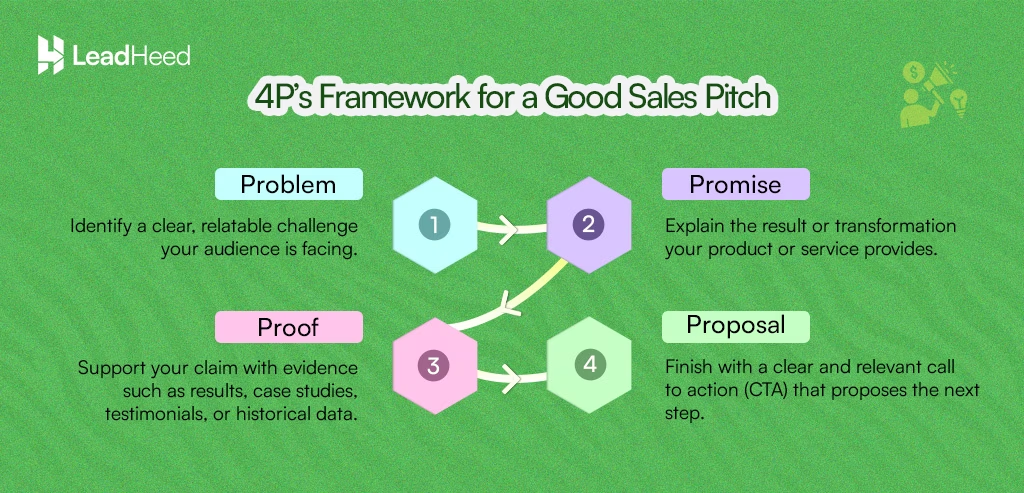
A simple 4P’s framework supports you in structuring the best sales pitch that works for the clients of every niche. It helps your pitch feel well-focused, well-structured, personalized, and results-driven to win your deal.
How to Write a Sales Pitch?
Writing a sales pitch works by building a relationship between the client’s need and what you can offer. Write a sales pitch by researching well about the targeted contacts, defining your objectives, and framing your pitch with a proper solution, including a convincing closing with a clear CTA. Use storytelling strategies and add a value proposition to the pitch, which actually boosts the sales process.
Consider the following things while writing a sales pitch:
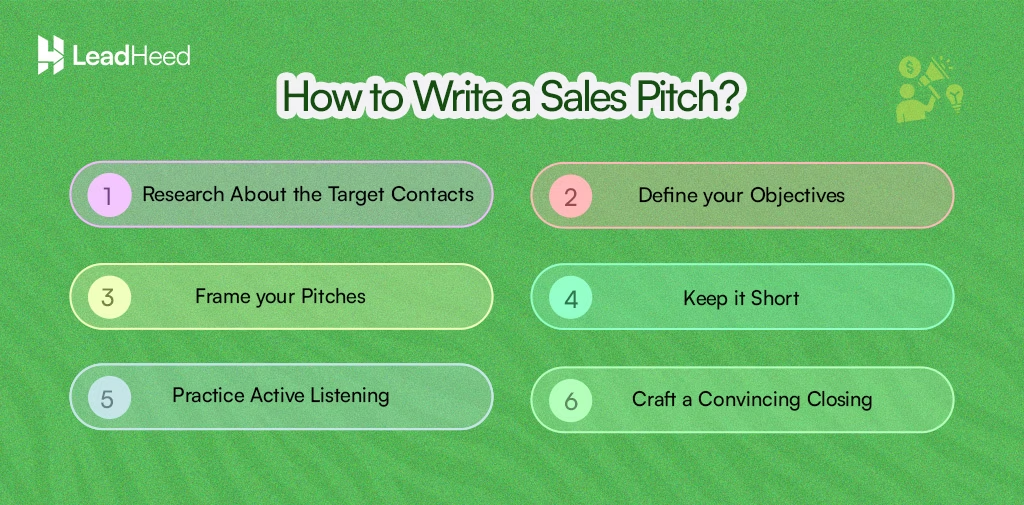
1. Research About the Target Contacts
Every contact identified through different inbound and outbound lead generation strategies is not verified and sales-ready. You should identify the contacts of prospects who are ready for sales pitching and have a high chance of paying for your product.
You must know the roles, nature, and behavior of a targeted prospect before you start writing a personalized pitch. Dig in with the historic purchase details and data before any action.
2. Define Your Objectives
Clearly define the goal of our sales pitch, whether it is for deal closure or securing a partnership. Having a goal in your mind helps you to draft your sales pitch targeting pin points of the prospect’s weakness. Relying on a simple script is not considered a good practice for sales pitching; you should write your pitch with a proper understanding.
3. Frame Your Pitches
Your pitches should be well customized and personally framed as per the nature and behaviour of the prospects. It should be well structured, based on the client’s specific problem and its solution. You can drive the interest of the prospect towards purchasing your product as a solution with a strategically framed sales pitch.
4. Keep it Short
Short and sweet pitches are interesting to listen to, whereas lengthy pitches with unwanted explanations make prospects feel bored and pushy. Prospects may also have less time for the conversation, so writing a strategic short pitch covering brand value, addressing the pain points, helps you get customers ready to pay for the product.
5. Practice Active Listening
Actively engage with the prospects, make them feel valued with open-ended questions, and encourage them for the conversation. Deliver a personalized sales pitch to make the prospect trust your product and feel their problems are being addressed. It is key to the success of sales pitching, as it helps you address the nature and behavior of prospects with their pain points.
6. Craft a Convincing Closing
As you should start perfectly, your closing should also be a compelling one, creating urgency for purchase. You can perfectly end your closing statement with a strong call to action (CTA), leading clients towards the next step for purchase. Clearly communicate the next step, like scheduling for the next meeting, direct purchase, or signing up for a free trial, and make sure your pitch is convincing.
Sales Pitch Examples
Your pitch and its style differ depending on the type of pitching you are about to deliver. It must be practical and also should not contain unnecessary statements that waste the time of readers.
Here are some examples of a sales pitch:
1. Elevator Pitch
Elevator pitch is the one that is short and sweet and best for direct pitching. It should be short, explaining what you offer in less than a minute of time. It is best when you need to deliver a quick introduction of your product, services, or value in small meetings or the first conversation.
Example of an Elevator Pitch
“Hi, I am [ Your Name] representing [Company Name], helping businesses solve [Specific Problem] by offering [product/services] that make [Desired result] faster, easier, and effective.
If you are interested in our [product/services], we can help you address your problem with the best results.”
2. Personalized E-mail pitch
This pitch is designed for a specific prospect and focuses on their possible needs and challenges. It is a generic and convincing email when compared to emails generated for mass outreach.
Example of Personalized Email Pitch
“Hi [Prospect’s Name],
I noticed that many companies in your business often face challenges with [specific problems]. I felt it might be useful to offer you [solutions] for the challenges your business is facing in this area.
If you are interested, I can share a few ideas that are relevant for your team.
Sincerely [Your Name]”
3. Cold Call Pitch
A cold call pitch is delivered when having a first conversation with a prospect in a phone call. In this pitching process, you should respectfully pitch your idea and must be designed to discuss sales more than forcing it.
Example of Cold Call Pitch
“Hi, [Prospect’s Name], this is [Your Name] from [Company Name]. I need 10 minutes of your time if you are interested in this conversation. I’m reaching out because we help businesses improve [specific process or outcome].
I wanted to briefly ask if this is something your team is currently working on. ”
4. Social Media Pitch
It is a casual and conversational way to start a sales pitch on social platforms like LinkedIn. It is relevant when you have already researched the prospect and now confidently deal with them. Start it naturally, being focused on the conversation.
Example of Social Media Pitch
“Hi, [Prospect’s Name],
I noticed your business is active in [Industry or Area]. We work with companies that want to improve [Specific Challenge] and get better results from [Process].
I would be happy to share a few ideas if this is relevant to you. Feel free to reply to this text.”
5. Demo Pitch
It is a pitch used when prospects need a closer look at the product and its features as a solution before choosing it. It helps them understand product value more clearly by seeing the real-time use of the product and services as a demo.
Example of Demo Pitch
“Hi [Prospect name], I am [Your name] from [Company].
We have [Product/Services] as a solution for the [problems] you have been facing. Rather than just talk about it, I would love to show you how this works in practice.
A short demo can give you a clear picture of how it helps solve [Problem] and provide you with [Specific Result].”
Common Mistakes to Avoid During a Sales Pitch
Many companies perform sales pitching unprofessionally and perform feature dumping. Faking urgency rather than promoting brand value is a bad practice, where strategic storytelling can change the whole game. You should not deliver your pitch without having proper knowledge of the product and sales strategies because you could fail while handling objections outside of your script.
Focusing on Features Rather than Value
Demonstrate the way each feature addresses a real-world issue or enhances performance, but don’t let your whole pitch depend on it. You should build the value of your product in the market while pitching a product instead of promoting its raw features. Your pitch should guide a prospect towards a solution rather than explaining every raw feature and making them feel bored.
Lack of Clarity and Professionalism
Using jargon and speaking the way you speak in daily life does not reflect your personality and professionalism. The language you are using should be professional, and everyone must be capable of understanding it to make their decision for the next step.
Depending on Scripts Only
Must avoid depending on a simple script you have copied or designed without any strategic planning, because without any specific product knowledge, your pitch is a waste. This practice degrades your brand value as you disappoint the prospects who have high expectations from your company.
Faking Urgency
Many organizations create fake urgency to sell their product, and cannot fulfill their promises later. This practice does not help you build longer relationships due to the fake promises you made while pitching. It is a crucial mistake that reduces your brand reputation and decreases brand sustainability.
Immediate Pitch
An immediate pitch makes the prospects feel pressured, and they don’t want to further converse because flooding new contacts with offers makes them feel uncomfortable. Instead of flooding with an immediate pitch, you should focus on building trust and rapport before pitching offers.
Final Thoughts
A successful sales pitch is not about conversing only; it is about saying the right things with clarity and purpose. When you focus on solving real problems, support your claims with proof, and guide your audience with a clear next step, your pitch naturally becomes more persuasive.
You need contact details and correct information about your prospect to deliver a good sales pitch. Using CRM software like LeadHeed, you can collect it through forms linked with your website or social media advertisements and tailor your sales pitch. You can identify the real pain of your prospects and score leads in CRM to create urgency. Sign up for LeadHeed!!!
Frequently Asked Questions (FAQs)
What are the most common mistakes in a sales pitch?
The most common sales pitch mistakes are overloading the prospects with unwanted information, failing to communicate a strong value proposition, and ending a pitch without a clear call to action.
How can I make my sales pitch more effective?
To make your sales pitch more effective, you should focus on your customer’s pain points, keep your message simple, support it with proof, and clearly explain the outcome your product or service delivers.
Why is proof important in a sales pitch?
Proof, such as testimonials, case studies, or data, is important in a sales pitch to persuade prospects to believe your claims, which builds trust and credibility.
How long should a sales pitch be?
A sales pitch has no fixed timing; it differs with its format and context, but generally, a normal sales pitch ends within 30 seconds to 2 minutes.
How does LeadHeed CRM help improve sales pitches?
LeadHeed CRM assists sales teams in personalizing their messaging, targeting the right audience, and following up consistently with the help of generated contacts and information of prospects through form links and QR codes.