
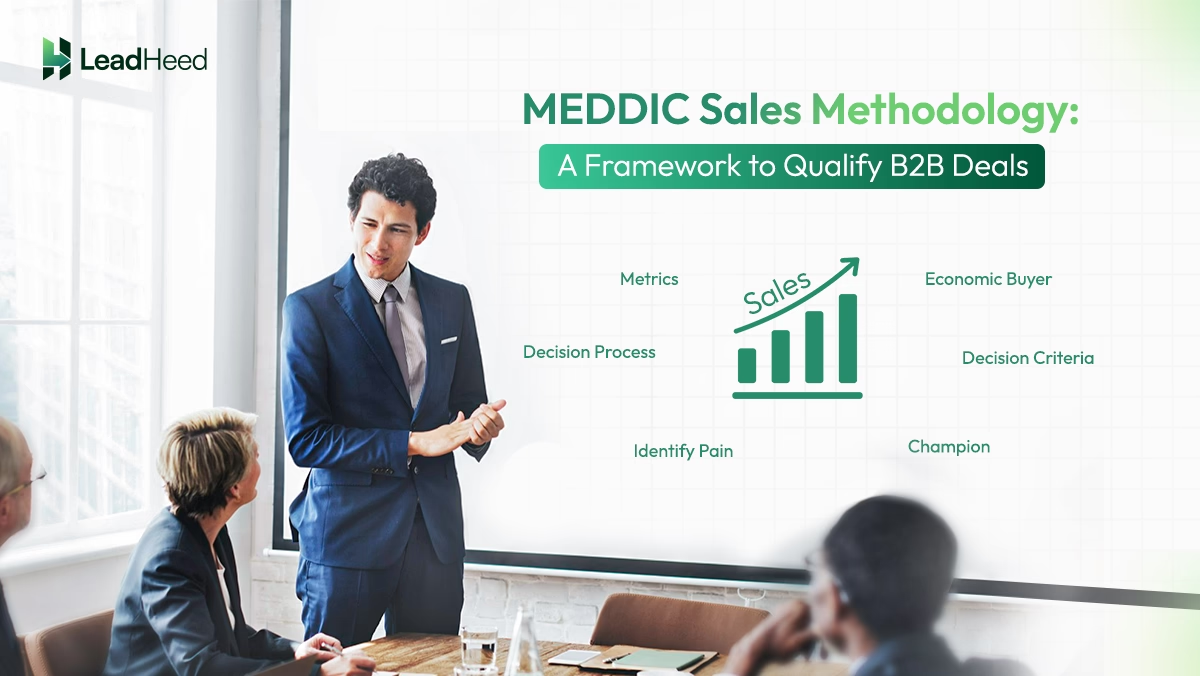
MEDDIC is a B2B sales qualification methodology that helps teams stop wasting time on deals that will not close. Many opportunities look promising at the start, but they stall later because the buyer has no clear urgency, no budget owner involved, or no defined decision path. The MEDDIC sales methodology helps you identify what outcomes the buyer wants, who approves spending, how they will decide, and who will drive the deal internally.
When you qualify deals with MEDDIC, you reduce surprises in the late stages and improve forecasting. You also build stronger deal control because every next step connects to real business pain and measurable impact.
What is MEDDIC Sales Methodology?
The MEDDIC sales methodology is a structured way to qualify B2B deals by confirming the six factors that decide whether a deal will close: Metrics, Economic Buyer, Decision Criteria, Decision Process, Identify Pain, and Champion.
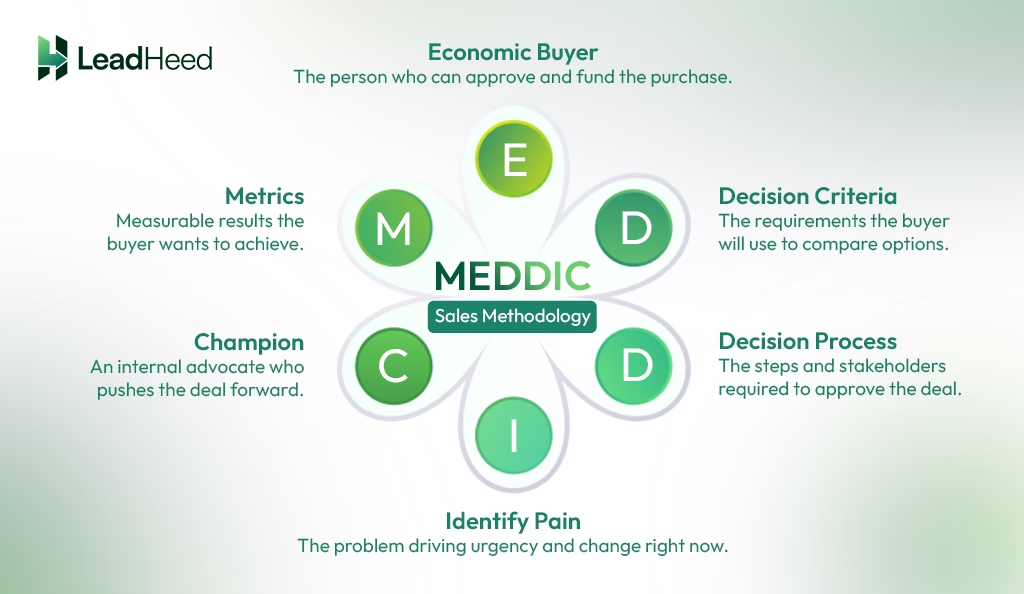
When you apply the MEDDIC sales process correctly, you uncover how the customer measures success, who can approve spend, what they will compare, how approvals happen, what problem they must solve, and who will advocate for you internally.
Instead of relying on “interest” or a good demo, MEDDIC makes you validate the buyer’s business outcomes, the budget owner, and the real decision path. It keeps your pipeline clean and helps your team focus on opportunities that have a clear reason to move forward.
Who Is the MEDDIC Sales For?
The MEDDIC sales framework fits teams selling higher-value B2B products or services where deals involve multiple stakeholders, longer timelines, and formal approvals. If your process includes discovery, demos, proposals, procurement or legal steps, and negotiation, MEDDIC helps you qualify the deal in a structured way instead of relying on “interest” or a good meeting.
How Does MEDDIC Work for Complex Sales?
The MEDDIC sales methodology works well for complex sales because it forces clarity early.
- MEDDIC makes you tie the deal to measurable outcomes (metrics), so the buyer has a strong business reason to act.
- MEDDIC pushes you to identify the economic buyer and confirm the real decision criteria and decision process, which prevents surprises late in the pipeline.
- MEDDIC helps you uncover real pain and build a champion who can sell internally when you are not in the room. It reduces deal risk and improves forecasting accuracy.
The MEDDIC Framework Explained
The MEDDIC sales methodology breaks qualification into six parts: Metrics, Economic Buyer, Decision Criteria, Decision Process, Identify Pain, and Champion. Below is what each MEDDIC element means, what to confirm, and the best questions to ask.
1. M — Metrics
Metrics focus on the business results your buyer cares about most. Instead of selling features, you connect your solution to measurable outcomes, so the deal has a clear reason to move forward and a clear way to prove success.
For most B2B prospects, the most important metrics are:
- Cost: What the buyer will spend in total (licenses, implementation, usage, and ongoing fees).
- Savings: The time or money they expect to save by fixing the current problem (less manual work, fewer errors, faster cycles).
- Return on Investment (ROI): The value they gain compared to the cost, based on real outcomes like revenue increase, churn reduction, or productivity improvement.
Your priority should be the deals where the buyer can clearly see a strong ROI. When the numbers are clear, the decision becomes easier, approvals move faster, and the deal becomes harder to ignore.
Questions to Ask:
- What result do you need from this in numbers?
- What does success look like in the next 90 days?
- What is the cost of the problem today (per week or per month)?
- How do you measure this today, and who owns that KPI?
- If you fix this, what improvement would make the purchase a clear win?
2. E — Economic Buyer
The Economic Buyer is the person who controls the budget and can approve the purchase. In complex B2B sales, your deal becomes risky if you only speak with users or influencers. You need to confirm who can say “yes,” what they care about, and what they must see before they sign.
For most deals, the Economic Buyer usually cares most about:
- Business impact: How the purchase improves revenue, cost, risk, or speed.
- Budget fit: Whether the investment matches the approved budget and timeline.
- Confidence: Proof the solution will work (results, references, implementation plan).
Your goal is to identify the Economic Buyer early and align your story to their priorities. When you get buy-in from the budget owner, deals move faster, and forecasting becomes more reliable.
Questions to Ask:
- Who has final approval for this purchase?
- Who owns the budget for this project?
- Has the budget already been allocated, or will it need approval?
- What does the Economic Buyer need to see to sign off?
- When can we involve them in a short call to confirm priorities and next steps?
3. D — Decision Criteria
Decision Criteria are the specific requirements your buyer will use to compare options and choose a solution. Deals often stall because the criteria stay unclear, change mid-way, or different stakeholders prioritize different things. When you confirm decision criteria early, you control the evaluation instead of guessing what matters.
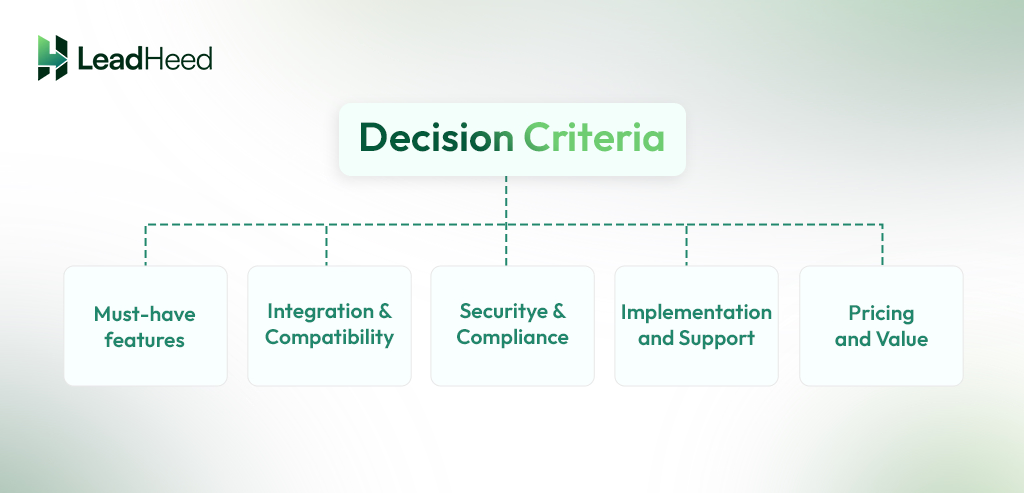
For most B2B deals, the most common decision criteria include:
- Must-have features: The core capabilities they cannot compromise on.
- Integrations and compatibility: How well the tool fits with their current systems and workflow.
Security and compliance: Data protection, access control, and any required standards. - Implementation and support: Setup time, onboarding, training, and ongoing support quality.
- Pricing and value: Total cost and how well it matches the expected ROI.
Your goal is to identify the top criteria, rank them by importance, and align your solution to those priorities. When you know the rules of the evaluation, you can position your product clearly and avoid late-stage surprises.
Questions to Ask:
- What criteria will you use to make the final decision?
- Which requirements are must-have vs nice-to-have?
- Who is involved in setting the criteria, and do they agree on priorities?
- What would make you reject a solution immediately?
- How will you compare two similar options if both meet your basics?
4. D — Decision Process
The Decision Process is the exact path the buyer follows to approve a purchase. It includes the steps, the people involved, the timeline, and any reviews from finance, procurement, legal, or leadership. Many deals fail not because the solution is wrong, but because the process was unclear until the end. When you confirm the decision process early, you reduce delays and remove surprises.
For most B2B deals, the decision process usually includes:
- Stakeholder alignment: The team agrees the problem is real and worth solving.
- Solution evaluation: Demos, trials, or vendor comparisons happen.
- Internal reviews: Finance, IT, security, and leadership review the proposal.
- Procurement and legal: Contract terms, payment terms, and compliance checks get approved.
- Final sign-off: The Economic Buyer or leadership approves and signs.
Your goal is to map the process step-by-step, assign owners to each step, and confirm target dates. When the process is clear, you can drive the next steps confidently and keep the deal moving.
Questions to Ask:
- What are the exact steps from today to a signed agreement?
- Who needs to be involved at each step (and who signs at the end)?
- What timeline are you working with, and what is driving that date?
- Are procurement, IT, or legal reviews required? If yes, when do they happen?
- What could delay approval, and how can we prevent it now?
5. I — Identify Pain
Identifying pain means finding the real business problem the buyer needs to solve and why it matters now. In complex sales, interest alone does not create urgency. Pain creates urgency. When you uncover what is broken, what it is costing them, and what happens if they do nothing, you give the deal a strong reason to move forward.
For most B2B prospects, pain usually shows up in three ways:
- Time pain: Work takes too long due to manual steps, slow handoffs, or repeated follow-ups.
- Money pain: They lose revenue, waste budget, or spend more to fix avoidable issues.
- Risk pain: Mistakes, missed deadlines, poor visibility, or compliance issues create business risk.
Your goal is to connect the pain to real impact and confirm it as a priority. When the pain is clear and urgent, buyers commit faster, and the deal becomes easier to justify internally.
Questions to Ask:
- What problem pushed you to look for a solution now?
- What happens if this stays the same for the next 3–6 months?
- How does this issue affect revenue, cost, or customer experience today?
- Who feels this pain the most inside your team?
- What have you already tried, and why did it not solve the issue?
6. C — Champion
A Champion is an internal person who wants the change and actively helps your deal move forward. In complex sales, you cannot sit in every internal meeting, so you need someone on the buyer’s side who will explain the value, handle objections, and keep the decision moving. A friendly contact is not always a champion—your champion must have influence and motivation.
A strong champion usually has three qualities:
- Personal stake: They benefit directly if the problem gets solved (time saved, better results, fewer headaches).
- Influence: They can shape opinions and access key stakeholders, even if they do not sign the contract.
- Commitment: They take action—introduce you to decision-makers, share internal context, and push next steps.
Your goal is to develop a champion by giving them clear value, a simple internal message, and support to sell the idea internally. When you have a real champion, deals move faster and close with less friction.
Questions to Ask
- Who benefits the most if this problem is solved?
- Who will push this forward internally when you are not in the room?
- What objections do you expect from leadership, finance, or IT?
- Can you introduce me to the Economic Buyer or key stakeholders?
- If we give you a short summary and ROI numbers, can you share it internally?
MEDDICC, MEDDPIC & MEDDPICC: What does the the extra letters mean?
MEDDIC works well for qualification, but many teams add extra letters when deals involve strong competition and formal approval steps. They help you reduce late-stage surprises and qualify “real deals” more accurately.
MEDDICC: What does the extra C mean?
In MEDDICC, the extra C stands for Competition. It means you confirm who you are up against and how the buyer is evaluating alternatives.
Even if the buyer likes your product, competitors can win if they match the criteria better, price lower, or have stronger internal trust.
Questions to Ask
- What other options are you considering (vendors or internal build)?
- What do you like about them, and what concerns you?
- If you choose another option, what will be the main reason?
MEDDPIC: What do the extra letters P and I mean?
In MEDDPIC, the extra letters are:
P — Paper Process: The contract and procurement steps needed to finalize the deal.
I — Implicate Pain: The deeper impact of the problem, including second-order effects and urgency.
P — Paper Process
Paper Process is the contract and procurement path required to finalize the deal. It covers legal reviews, security checks, vendor onboarding, payment terms, and who signs what.
Questions to Ask
- What is the contract process from approval to signature?
- Who reviews legal and procurement terms?
- What is the typical timeline for contracts in your company?
- Are there required steps like vendor registration or security review?
I — Implicate Pain
Implicate Pain means going deeper than “this is a problem” and confirming the real consequences of not fixing it. It connects the pain to measurable loss, risk, and urgency.
Questions to Ask
- What does this problem cost you each month in time, money, or risk?
- Who gets impacted when this issue happens?
- What happens if nothing changes this quarter?
- What is the business impact if the timeline slips by 30–60 days?
MEDDPICC: What does the extra C mean here?
In MEDDPICC, you include Paper Process (P) and Implicate Pain (I) plus Competition (C). This makes it the most complete option for enterprise deals where procurement/legal and competitive pressure often decide the outcome.
When to use which:
MEDDIC: Fewer stakeholders, simpler buying process.
MEDDICC: Competition plays a major role.
MEDDPICC: Enterprise deals with procurement/legal + competition.
How to identify if the MEDDIC sales methodology is for your business?
MEDDIC works best when your sales process has real complexity. If your deals involve multiple stakeholders, approvals, and a longer timeline, MEDDIC helps you qualify properly and stop wasting time on “maybe” opportunities.
MEDDIC is a good fit if:
- Your sales cycle is longer than 2–4 weeks, and deals do not close in one call.
- More than one person influences the decision (users, managers, finance, IT, leadership).
- Budget approval is not automatic, and someone must sign off on spending.
- Prospects compare multiple vendors or consider internal alternatives.
- You often lose deals late because of procurement, legal, or “we chose another option.”
- Your pipeline feels unreliable because reps rely on opinions instead of validated details.
MEDDIC may be too heavy if:
- You sell low-cost products with fast, transactional decisions.
- Most customers buy on the spot with minimal approval steps.
- Your sales process is mainly self-serve or e-commerce style.
Alternative Sales Qualification Methodologies
MEDDIC is a strong sales methodology for complex B2B deals, but it is not the only framework. Some teams prefer simpler or more conversational methods depending on deal size, sales cycle, and how buyers make decisions.
BANT
BANT stands for Budget, Authority, Need, and Timeline. It’s a classic sales methodology that helps you qualify leads by checking if the buyer can pay, who decides, what they need, and when they plan to buy. BANT works best for shorter sales cycles and mid-to-low complexity deals where decisions are straightforward.
Best for: quick qualification, inbound leads, smaller deal sizes
Limitations: can be too shallow for enterprise deals with multiple stakeholders
SPIN
SPIN stands for Situation, Problem, Implication, and Need-Payoff. It is a question-led framework that helps you run better discovery calls. Instead of jumping to features, SPIN helps you uncover the real problem, explore consequences, and guide the buyer toward value.
Best for: discovery calls, consultative sales, solution selling.
Limitations: does not directly map budget authority or formal decision steps.
SPICED
SPICED stands for Situation, Pain, Impact, Critical Event, and Decision. It focuses on what hurts, why it matters, what deadline makes it urgent, and how the buyer will decide. SPICED is popular in B2B because it balances qualification with urgency.
Best for: pipeline qualification with urgency, mid-market B2B.
Limitations: less detailed around procurement/legal compared to MEDDPICC.
NEAT
NEAT stands for Need, Economic Impact, Access to Authority, and Timeline. It is a modern alternative to BANT that goes deeper into value. NEAT helps you qualify based on business impact and decision access, not just budget.
Best for: value-based qualification, teams that find BANT too rigid.
Limitations: still lighter than MEDDIC for very complex, multi-step approvals.
Using MEDDIC Inside a CRM
MEDDIC works best when you track it consistently, not just in your head or scattered notes. A CRM helps you document each MEDDIC element in one place, so every deal has clear qualification details, clear next steps, and fewer surprises late in the pipeline.
- Create MEDDIC fields for every deal: Metrics, Economic Buyer, Decision Criteria, Decision Process, Identify Pain, Champion.
- Add simple status markers (Green / Yellow / Red) so reps can spot deal risk quickly.
- Attach notes and proof like call summaries, ROI numbers, stakeholder roles, and decision timelines.
- Use tasks and reminders to drive next steps (economic buyer call, procurement check, champion alignment).
- Review MEDDIC in pipeline meetings so deals only move forward when key info is confirmed.
LeadHeed makes it easier to apply MEDDIC without creating a complicated workflow. You can track deals through a clear pipeline, store MEDDIC notes inside each opportunity, and set tasks and reminders so important steps do not get missed. Sign up for LeahHeed for free and stay consistent with qualification and follow-ups!!
FAQs
What does MEDDIC mean in sales?
MEDDIC is a sales qualification framework that helps you confirm whether a deal is real and likely to close. MEDDIC stands for Metrics, Economic Buyer, Decision Criteria, Decision Process, Identify Pain, and Champion.
What are the stages of MEDDPICC sales?
MEDDPICC is not a “stage-based” funnel. It is a qualification checklist you validate across your pipeline. The elements are: Metrics → Economic Buyer → Decision Criteria → Decision Process → Paper Process → Implicate Pain → Champion → Competition.
What is the MEDDIC sales checklist?
A MEDDIC checklist is a simple set of questions you use to confirm each area before you move a deal forward:
Metrics: Do we have measurable outcomes and a baseline?
Economic Buyer: Do we know who signs and has access to them?
Decision Criteria: Do we know the must-haves and priorities?
Decision Process: Do we know the steps, stakeholders, and timeline?
Identify Pain: Is the problem urgent with a clear impact?
Champion: Do we have an internal advocate with influence?
What is the difference between MEDDIC and MEDDPICC?
MEDDIC covers the core qualification signals: Metrics, Economic Buyer, Decision Criteria, Decision Process, Identify Pain, Champion, while MEDDPICC adds three additional checks:
- P — Paper Process (procurement/legal/contract steps)
- I — Implicate Pain (deeper consequences and urgency)
- C — Competition (who/what you compete against)
What is the difference between MEDDPICC and BANT?
BANT (Budget, Authority, Need, Timeline) works best for shorter cycles and less complex deals, while MEDDPICC goes deeper for complex B2B sales by validating decision criteria/process, champion strength, procurement/legal steps, competition, and measurable business impact.