

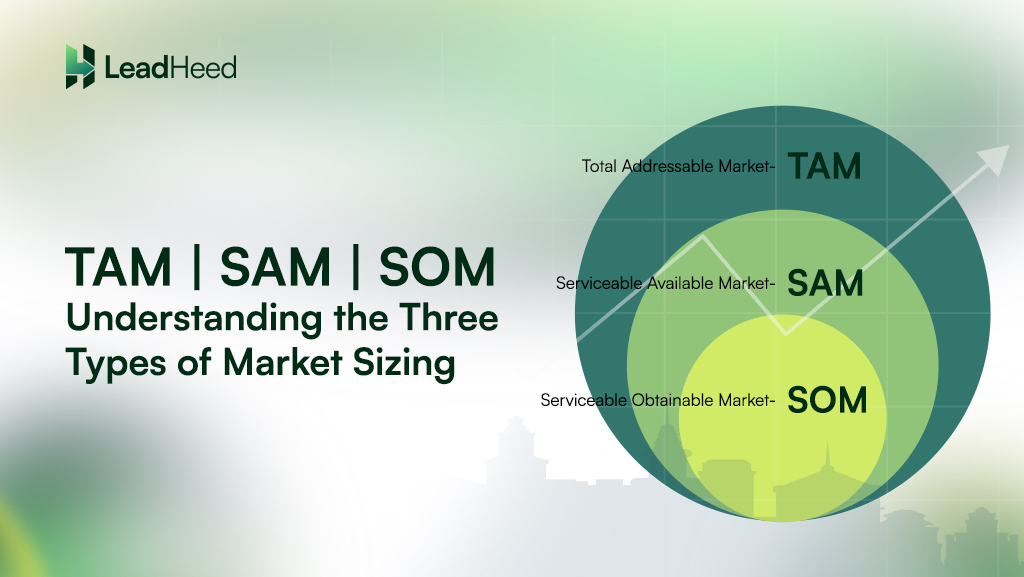
TAM, SAM, and SOM are hierarchical metrics used to estimate the market size and potential revenue. They are used to define and quantify the market opportunity of a business, representing a hierarchical “nested circle” approach to know the market size. They move from a broad theoretical dream scenario to a narrow and realistic on-ground target.
Highlights
- TAM, SAM, and SOM, as hierarchical metrics, help businesses assess market attractiveness, identify growth opportunities, and set realistic revenue targets.
- TAM stands for Total Addressable Market, which is the total revenue opportunity for a product or service if it achieved 100% market share.
- SAM stands for Serviceable Addressable Market. It is the portion of TAM that businesses can realistically reach and serve within their current geography, resources, and product capabilities.
- SOM stands for Serviceable Obtainable Market. It is a portion of the SAM that businesses can realistically capture and serve in the near term, considering currently available resources, competition, and geographical limitations.
What is TAM?
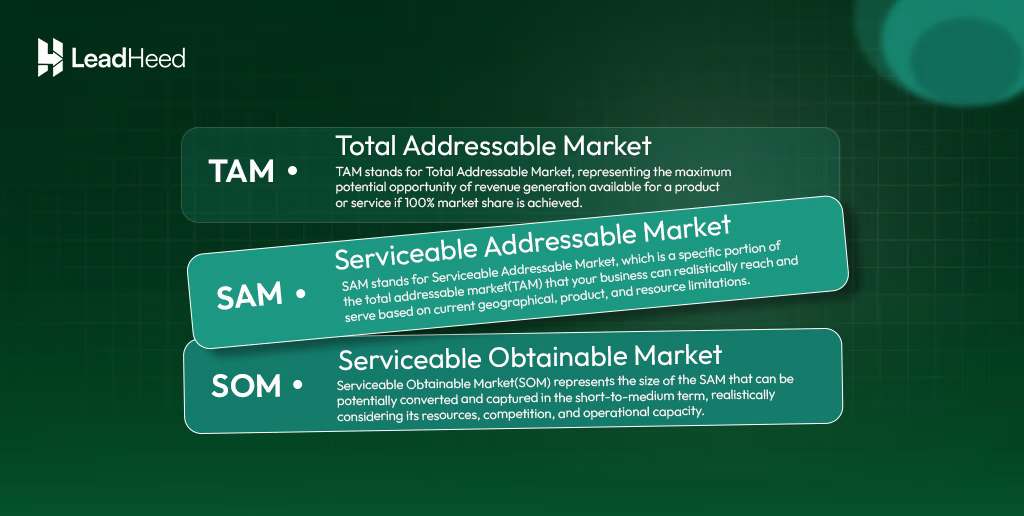
TAM stands for Total Addressable Market, representing the maximum potential opportunity of revenue generation available for a product or service if 100% market share is achieved. Simply, it is the total demand for a product or service. It measures the overall demand, often used by business investors to determine the scale of business opportunities.
For example, if a company develops new CRM software for a sales and marketing agency, the TAM is the total annual revenue if every single sales and marketing agency in the world bought that CRM software.
What is SAM?
SAM stands for Serviceable Addressable Market, which is a specific portion of the total addressable market (TAM) that your business can realistically reach and serve based on current geographical, product, and resource limitations. It represents the marketable segments, helping to refine marketing strategies and set achievable revenue goals.
What is SOM?
Serviceable Obtainable Market (SOM) represents the size of the SAM that can be potentially converted and captured in the short-to-medium term, realistically considering its resources, competition, and operational capacity. It is the most achievable market segment, used to set realistic sales targets and forecast revenue.
How to Calculate TAM, SAM, and SOM?
Calculating TAM, SAM, and SOM helps you understand the full market opportunity for your business, the portion of that market you can actually serve, and the share you can realistically capture. You can estimate market size, evaluate growth potential, and build more realistic business and revenue plans.
How to Calculate TAM?
The Total Addressable Market (TAM) represents the absolute maximum revenue your business could generate if you captured 100% of the market with zero competition. It is calculated by multiplying the total number of potential customers in a target market by the annual revenue per customer.
The fundamental formula for TAM calculation is:
Total Addressable Market (TAM) = Total Customers × Average Annual Revenue per Customer
How to Calculate SAM?
To calculate the Serviceable Addressable Market (SAM), identify the specific segment of your TAM that your product can realistically reach based on your current geography, technology, and business model.
The fundamental formula for SAM calculation is:
Serviceable Addressable Market (SAM) = Target Segment of TAM × Average Annual Revenue per Customer
How to calculate SOM?
Serviceable Obtainable Market (SOM) is commonly calculated by multiplying last year’s market share percentage by this year’s SAM, or it can be calculated by forecasting the total number of reachable customers and multiplying that figure by the average revenue expected per user.
The fundamental formula for SOM calculation is:
Serviceable Obtainable Market (SOM) = Last Year’s Market Share% × This year’s SAM
Example: TAM, SAM, and SOM
For example, you are calculating TAM, SAM, and SOM of a US-based manufacturing software(SaaS). Then:
1. TAM (Total Addressable Market)
This is the total demand for your product if you captured 100% of the market.
Example:
You’re launching an online food delivery app.
- Total people in a country: 30 million
- Average spending on food delivery per year: $100
- TAM = 30M × $100 = $3Billion
2. SAM (Serviceable Available Market)
This is the portion of TAM you can actually target based on your business model or location.
Example:
Your app only operates in major cities with 10 million people.
- SAM = 10M × $100 = $1Billion
3. SOM (Serviceable Obtainable Market)
This is the realistic share you can capture in the near term.
Example:
You expect to capture 5% of the city market.
- SOM = 5% of 1 Billion = $50 Million
Why do TAM, SAM and SOM matter for the business roadmap?
TAM, SAM, and SOM define the market potential and realistic growth milestones, and guide you on resource allocation. They validate market viability, justify investment, and define realistic growth targets.
When you filter total demand (TAM) by serviceable areas (SAM) and define an obtainable, actionable slice (SOM), it helps you prioritize the sales efforts, align team objectives, and convince investors of a realistic, expanded growth plan.
Validate Market Potential and Possibility
Total Addressable Market (TAM) validates that the market is large enough to warrant the investment of time, capital, and resources. It is the foundational step in market analysis, providing the context needed to prove the overall opportunity, ensuring the market potential is large enough with an exact target audience.
Guides Go-to-Market Strategy
Serviceable Addressable Market (SAM) allows businesses to focus on a specific reachable market, helping in creating targeted marketing channels, strategies, and pricing models. TAM, SAM, and SOM guide you to develop a go-to-market strategy by identifying the most attractive market opportunities and ideal customers, and developing strategies accordingly to reach and engage.
Set Realistic Growth and Sales Targets
The difference between TAM and SAM shows exactly where the business can expand in future roadmaps, helping investors to set realistic and possible growth targets. SOM also represents the share of the market that can be realistically captured and used to set possible goals, rather than facing problems with unrealistic expectations.
Informs the product roadmap and expansion
TAM, SAM, and SOM are the metrics that help in identifying gaps for new product features and geographical expansion. A small SOM comparison over a large TAM may indicate that a more focused strategy is required during expansion.
The following table shows the specific roles of TAM, SAM, and SOM:
| Metrics | Roles in Roadmap | Main Focus |
| TAM | The Vision. | Set the long-term goal. |
| SAM | The Strategy. | Defines the targeted and reachable market. |
| SOM | The Execution. | Drives immediate targets for 1-2 years. |
Conclusion
An established TAM, SAM, and SOM analysis will give an indication to the investors that you are fully aware of who is paying for your product and how you will succeed in a competitive environment. It transforms a general concept into a workable, practical business strategy. You can stop your credibility from being damaged by market enhancement or your ambition being hampered by a lack of analysis.
Using CRM software bridges the gap between the broad business objectives and daily sales business, with the opportunity of easily targeting the right customers and opportunities. LeadHeed CRM provides you with a clear analytics dashboard that makes sales and revenue tracking easier, providing both teams and investors with an improved perspective on performance.
Frequently Asked Questions
What are the key types of market size?
The three types of f market size are Total Addressable Market (TAM), Serviceable Addressable Market (SAM), and Serviceable Obtainable Market (SOM).
Why do investors ask for TAM, SAM, and SOM?
Investors ask for TAM, SAM, and SOM to examine startup growth potential, commercial feasibility, and strategic focus towards goals.
Can SAM be larger than TAM?
No, a serviceable addressable market (SAM) cannot be larger than the total addressable market (TAM) because TAM represents the total demand of a product in the market, but SAM is a smaller subset of that market.
Can I use TAM, SAM and SOM for a startup without historical data?
Yes, you can use TAM (Total Addressable Market), SAM (Serviceable Addressable Market), and SOM (Serviceable Obtainable Market) for a startup without historical data. They help new businesses validate their potential, and in the early stages, it relies on research rather than internal data.