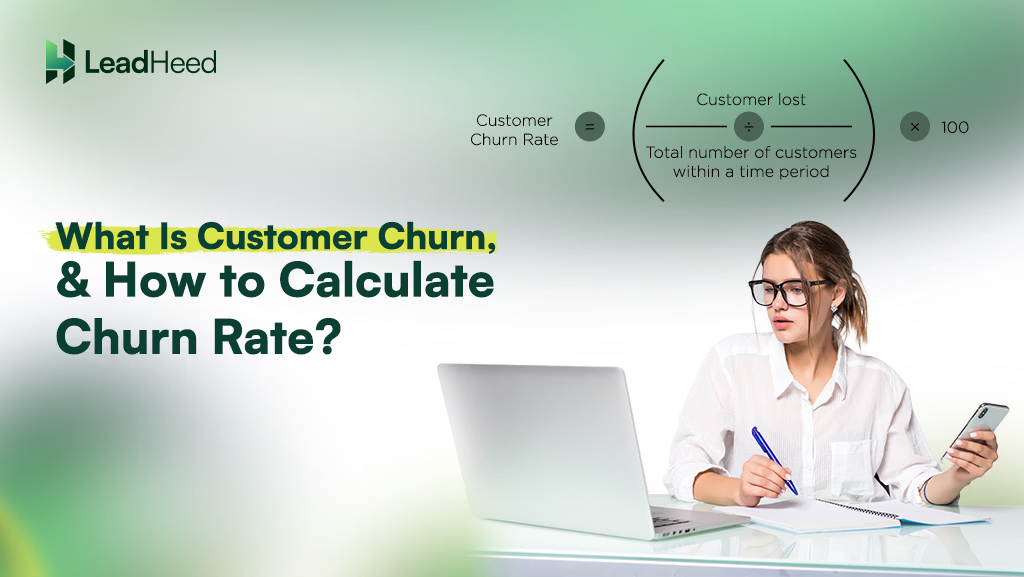

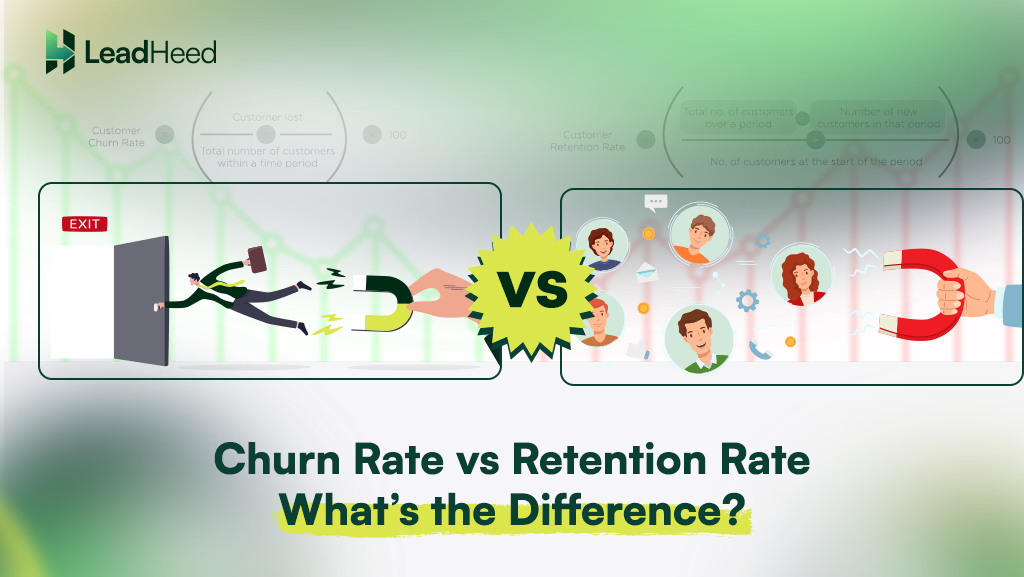
Customer churn and customer retention are two important KPIs (Key Performance Indicators) of a business. Customer retention shows you how many of your customers are continuing to use your business and also tells how well your retention strategies are working. Meanwhile, the churn rate tells you how many customers are stopping using your business.
When calculated and analyzed together, customer retention and customer churn rate give you a clearer sense of your business, whether it is succeeding or there is a problem.
Highlights
- Customer churn and customer retention have an inverse relationship because they measure two opposite metrics: churn measures customers you lose, and retention measures the customers you keep.
- Customer churn rate is defined as the rate of customers who have stopped using products and services over a specific time period.
- Customer retention rate is defined as the rate of customers who are still using or renewing the subscription to the product or services over a specific time period.
- Customer churn rate = (Customers Lost / Total Customers at Start) x 100%
- Customer retention rate = [(Customers at end – New customers) / Total Customers at Start] x100%
What is Customer Churn, and How Do You Calculate Churn Rate?
Customer Churn is defined as the percentage of people who stop using the product or services of an organization after using them for some period of time. It is particularly relevant for businesses that operate on a subscription-based or ongoing service model. A higher Customer turnover rate is not good for a sustainable business. Keeping customer churn rate low ensures your customer base stays strong and stable, positively impacting your revenue growth.
Customer Churn Rate Calculation Formula
The customer churn rate is calculated by dividing the number of customers lost by the company during a timeframe by the total number of customers at the start of the period and multiplying it by 100%. The calculation formula applicable for monthly, quarterly, and yearly calculations is as follows:
Customer Churn Rate = Number of Customers LostTotal Number of Customers at Start × 100%
For Example:
If you start a business with 100 customers and you lose 7 customers.
Here’s how you calculate churn rate:
- Divide lost customers by the number of customers at the start: [7/100] = 0.07
- Multiply the result by 100%: 0.07 × 100% = 7%
- So, the Customer churn rate is 7%
What is Customer Retention, and How Do You Calculate Retention Rate?
Customer retention rate is the percentage of customers who continue to use a company or business’s product or services over a specific period. It is a key indicator of customer loyalty and satisfaction with sustainable business. It shows how strong a customer and a business can be in a relationship. Better retention can make a business financially stable and long-lasting in the future.
Customer Retention Rate Calculation Formula
The customer retention rate calculation formula measures the percentage of existing customers a business is successful in keeping over a specific time period.
Formula to calculate customer retention rate:
Customer Retention Rate = Customers at end − New CustomersTotal Number of Customers at Start × 100%
For example:
If you start a quarter with 200 customers, gain 50 customers, and end with 220 total customers, where 30 churned, then the customer retention rate is calculated as:
- Subtract new customers from customers at the end: 220 – 50 = 170
- Divide by starting customers: 170/220 = 0.85
- Multiply the result with 100%: 0.85 x 100% = 85%
- So, the customer retention rate is 85%.
Customer Churn vs Customer Retention: Key Differences
The main difference between customer churn and customer retention is that churn focuses on customers stopping to use a product, but retention focuses on customers who stay with the product, renewing it. Some other key differences are:
| Feature | Customer Churn | Customer Retention |
| Definition | Customers are stopping the use of products and services. | Customers are staying and renewing their subscriptions. |
| Focus | Customer loss and risk. | Customer loyalty and stability. |
| Key Metric | Churn Rate (% lost). | Retention Rate(% retained). |
| Indicates | Poor product fit, Bad experience, competition, etc. | High value, satisfaction, product-market fit, etc. |
| Financial Impact | It has a negative impact. | It has a positive impact. |
| Goal | Minimizes the profit with revenue. | Maximizes the profit with revenue. |
| Actionable insights | Why do Customers Leave? | Why do customers stay? |
| Relation | The inverse of retention. | The inverse of churn. |
| Focus | It focuses on reducing customer frustration. | It focuses on customer relationship development. |
How Churn and Retention Impact Business Growth?
Customer retention rate vs churn rate are primary drivers for sustainable business growth, impacting revenue, profits, and customer satisfaction levels. High churn acts as a leaky bucket because a business with high customer attrition loses revenue and users through the bottom as fast as it adds them to the top so, customer retention should be aimed by every organization for their revenue growth.
Impacts of Churn on Business Growth
Decrease in Revenue
A decrease in revenue due to Customer churn reduces the customer base and recurring income. Especially in SaaS or subscription-based businesses, it causes a huge drop in Monthly Recurring Revenue(MRR), reducing the overall revenue growth.
Increased Cost
Gaining new customers is more expensive than retaining the existing ones, making high churn financially draining and costly. Various sales and marketing expenses will be added on if customer churn is at a high rate, and also requires high costs.
Damaged Reputation
High churn is an indicator of low customer satisfaction and poor customer experience, which can hamper the new customer acquisition process with a damaged reputation. A damaged reputation cannot build proper trust among new customers and may also fade among the ones already using it.
Lowered Valuation
Consistency in high churn rate signals instability to the investors, which often negatively impacts the company’s valuation. The business with high churn rates will have less value, as there are fewer customers remaining who may also fade due to the lower valuation of the company.
Impacts of Retention on Business Growth
Increase in Profits
Retained customers are very likely to make repeat purchases and are less price sensitive, allowing the company to gain a good profit margin. Retaining customers is much cheaper than acquiring new customers, which can also be considered a profit for the company.
Higher Customer Lifetime Value (CLV)
Loyal customers buy products and services more frequently and are more likely to purchase new products or updates. Among 100 customers, the top 10 customers often spend more than the remaining 90. As long-term and loyal customers are more likely to spend, this shows the higher customer lifetime value in a business.
Improved Brand Value
Retained customers provide referrals, reducing the high cost of advertising and marketing, which is considered an improvement in brand value. As many referrals as customers provide, this shows a higher brand value and business growth.
Cost-Efficient Marketing
The more customers retained, the less the company should spend on marketing. Marketing for new customers is more expensive than for the retained ones. Retained customers do not require heavy marketing costs.
Strategies to Reduce Customer Churn and Improve Customer Retention
Customers dealing with your product should trust your product and feel valued, too. Reducing customer churn requires a multi-directional approach focusing on enhancing customer experience, onboarding, and engagement. Key strategies include:
I. Enhanced Onboarding
Creating a smooth start by providing clear information about products and services, along with a good tutorial, helps customers understand and learn about products and policies properly. Enhanced start also points towards true promises in the sales and marketing process, which makes customers believe in the product and services provided by the organization. This prevents early churn and retains the customers due to the best products and services being provided with good first impressions.
II. Proactive support and Services
Providing an active 24/7 support to the customers as a service of the business is essential for the customers and helpful as well for new customers. Reaching out to customers who face frequent issues, helping customers solve their issues on time, and ensuring they won’t get frustrated easily due to the multi-channel support, decreases customer churn and helps in retaining the customers.
III. Build a Community
Encouraging customers to engage and communicate their thoughts and problems with other customers by creating groups or forums creates transparency among customers, and they can build deeper emotional connections and brand advocacy through the community easily, without any extra effort. Not only for customers, but businesses can also study their weaknesses through the community, which needs to be addressed.
IV. Personalization and Engagement
Using CRM data, companies can tailor personalised interactions and offers to understand customer behaviour and preferences, which brings maximum customers into engagement with the offers. Personalised emails and calls make customers feel that they are being valued, which makes them renew the subscription instead of stopping to use it.
V. Realign value and Pricing
Businesses should be aware of their pricing and the value being delivered to customers to keep it competitive in the market. Reconnecting to customers to remind them about the value they are receiving at the price is also a very good step to reduce customer churn and increase retention.
VI. Act on Customer Feedback
Customer feedback is a valuable asset to understand the real pain points of the customers for necessary improvements. Businesses should actively collect feedback through feedback forms, interviews, and surveys to work on drawbacks and problems. Customers also trust the product if they notice their issues being solved after providing feedback.
Conclusion
Customer churn and customer retention are two parts of business, acting as critical and inverse metrics for business health. A combination of low churn and high retention indicates the business is sustainable and is focused on growing its revenue, whereas high churn indicates product failure. Together, both churn and retention determine sustainable revenue and customer lifetime value(CLV). A high churn rate indicates that the business requires improved onboarding and product value, whereas a high retention rate indicates that the business is performing well.
Any business that intends to achieve a sustainable level of success must improve retention and decrease churn. Using a CRM system like LeadHeed helps you control the relations with customers more efficiently, remain interested, and earn their loyalty. Sign up for LeadHeed for free!
Frequently Asked Questions (FAQs)
What is the relationship between churn rate and the retention rate?
Churn rate and retention rate share an inverse relation, where an increase in churn rate decreases the retention rate of a business. For example, if you start a business with 100 customers and lose 10 customers at the end of the year, your retention rate will be 90%, and your churn rate will be 10%.
Can customer churn be positive?
Yes, sometimes churn helps in removing unprofitable and inactive customers, which helps businesses focus on high-value customers.
What is considered a good retention rate?
A good retention rate varies by industry. But SaaS businesses often aim for a retention rate of 90% or above. It is linked to a churn rate of less than 90%.
How can I identify at-risk customers?
At-risk customers can be identified by monitoring for a decrease in product usage, missed payments, or negative sentiment in surveys.
What should I focus on: acquisition or retention?
Compared to acquisition, retention is much more cost-effective and time-efficient. Generally, a slight increment in retention is much more profitable and sustainable than acquisition because good customer relations are already developed among retained customers.