
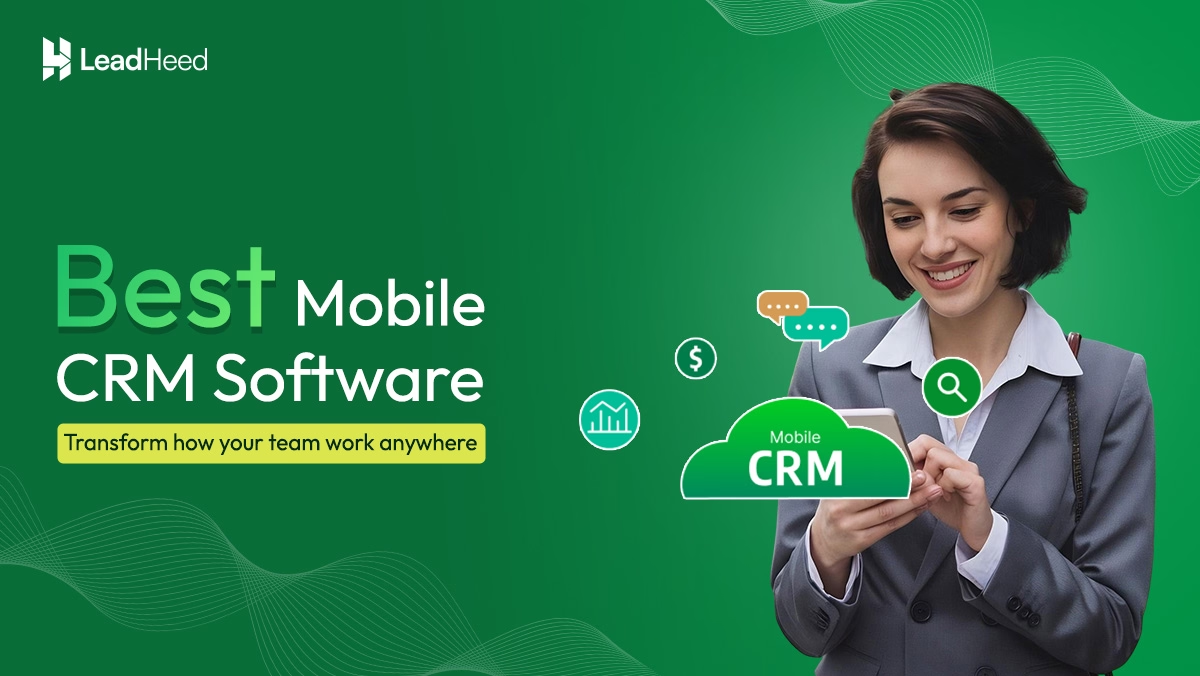
Businesses often lose prospects simply because their CRM tools aren’t accessible on the move. Delayed responses, inconsistent data, and disconnected teams create frustration for both employees and customers.
The best mobile CRM keeps your sales, marketing, and support teams connected in real-time, with seamless access to leads, contacts, and analytics. Mobile CRM apps allow instant updates, smarter decision-making, and faster deal closures, helping businesses turn missed opportunities into revenue growth.
Explore how top mobile CRM software empowers your team to manage leads, track customer interactions, and close deals efficiently—anytime, anywhere.
What is Mobile CRM Software and Its Key Benefits?
Mobile CRM software is a tool that lets your team access customer relationship management features directly on smartphones and tablets. It puts all your CRM data in the palm of your hand so that you can manage sales, marketing, and customer service on the go.
Some key benefits of Mobile CRM software include:
- Real-time Access: Your team members can view, edit, and update customer information on their mobile devices from anywhere. This ensures essential data is always current and accessible.
- Team Collaboration: Mobile CRM enables flawless communication among sales, marketing, and support teams. Sharing updates, assigning tasks, and collaborating on deals becomes faster and more efficient.
- Instant Updates: Leads, opportunities, and customer interactions are updated in real time. This keeps everyone on the same page and reduces errors or missed opportunities.
- Improved Customer Interactions: With immediate access to customer data, teams can respond quickly, tailor conversations, and provide personalized experiences that enhance satisfaction and loyalty.
What are the Risks of Not Using a Mobile CRM?
Relying solely on desktop CRM systems can put your team at a disadvantage. Without mobile access, sales, marketing, and customer service teams may face delays, missed opportunities, and decreased productivity. Here’s a closer look at the key risks:
- Missed Appointments and Tasks
Teams without mobile CRM access may forget meetings, deadlines, or follow-ups while traveling or working remotely. This can harm your client relationships and create bottlenecks in workflows.
- Delayed Follow-Ups
Without instant access to updated customer information, responding to leads or client queries takes longer, resulting in frustration and potential business loss.
- Connectivity Issues
Team members working outside the office may struggle to access critical data, making it difficult to provide accurate, timely information to customers.
- Lost Updates Across Devices
When data isn’t synchronised in real time, entries made on one device may not appear on another, leading to confusion, errors, and duplicate work.
- Reduced sales efficiency
Limited access to CRM tools slows down pipeline management, reporting, and team collaboration. This ultimately impacts your revenue growth and customer satisfaction.
Top 10 Mobile CRM Tools to Consider in 2026
With so many CRM platforms available today, choosing the right mobile-friendly CRM can feel overwhelming. To make it easier, we’ve rounded up the top 10 mobile CRM tools in 2026 that stand out for usability, features, and business fit.
1. Salesforce Sales Cloud
A robust CRM platform offering enterprise-grade customization, AI insights, and seamless integration, suitable for large organizations.
Features:
- Customizable workflows and dashboards
- AI-powered predictive analytics
- Extensive integration with third-party apps
Pros:
- Highly scalable for large teams
- Strong reporting and analytics
- Mobile app with offline access
Cons:
- Steeper learning curve
- Premium pricing
2. HubSpot CRM
HubSpot CRM is versatile and user-friendly, supporting real-time updates, team collaboration, and a full suite of marketing and sales tools.
Features:
- Contact and deal management
- Team collaboration tools
- Marketing automation
Pros:
- Free plan available for small teams
- Easy to use and set up
- Good integration with apps and tools
Cons:
- Limited advanced reporting on the free plan
- Some features require paid tiers
3. Zoho CRM
Zoho CRM offers AI-driven insights, workflow automation, and integration with Zoho apps, making it suitable for SMBs seeking mobile access.
Features:
- Workflow automation
- Predictive lead scoring
- Multi-channel communication tools
Pros:
- Affordable pricing
- Mobile-friendly interface
- Strong integration ecosystem
Cons:
- Advanced features require higher-tier plans
- Limited pre-built reports
4. Pipedrive
A sales-focused CRM with a visual pipeline, mobile app access, and tools to manage deals and communications efficiently on the go.
Features:
- Visual sales pipeline
- Deal and task tracking on mobile
- Mobile app with notifications
Pros:
- Intuitive interface
- Focused on sales performance
- Easy mobile access
Cons:
- Limited marketing features
- Fewer customization options
5. Zendesk Sell
Zendesk Sell is tailored for mobile sales teams, providing real-time access to customer data, task management, and seamless communication.
Features:
- Lead and contact management
- Mobile app with offline access
- Task and activity tracking
Pros:
- Ideal for mobile-first sales teams
- Strong customer support features
- Integrates with the Zendesk ecosystem
Cons:
- Focused more on sales than marketing
- Learning curve for new users
6. Freshsales
Freshsales combines built-in calling, email logging, and a mobile app, making it suitable for small to mid-sized teams needing a mobile CRM.
Features:
- Contact and deal management
- Email and call tracking
- Mobile app with push notifications
Pros:
- Affordable pricing for small teams
- Easy to set up
- Automation capabilities
Cons:
- Limited advanced analytics
- Not ideal for huge enterprises
7. Capsule CRM
Capsule CRM offers a lightweight interface, offline access, and voice-to-text note-taking, perfect for professionals on the move.
Features:
- Contact and task management
- Offline mobile access
- Voice-to-text notes
Pros:
- Simple and easy to use
- Lightweight mobile app
- Affordable for small teams
Cons:
- Limited advanced features
- Fewer integrations
8. Keap
Keap is a cloud-based CRM system for small businesses, combining sales, marketing, and eCommerce automation with mobile access.
Features:
- Marketing automation
- Sales pipeline tracking
- eCommerce integrations
Pros:
- Good automation capabilities
- User-friendly interface
- Mobile app for instant updates
Cons:
- Higher cost for advanced plans
- Limited enterprise-level features
9. Lark
Lark is an all-in-one mobile-first platform integrating CRM capabilities with communication and collaboration tools.
Features:
- Integrated CRM and messaging
- Mobile-first dashboard
- Task and project management
Pros:
- Combines collaboration and CRM
- Strong mobile usability
- Real-time updates
Cons:
- Less focused on deep CRM analytics
- Some advanced features require paid plans
Comparison of the Best Mobile CRM Platforms
When choosing the best mobile CRM for your team, it’s crucial to compare usability, pricing, and suitability for different business needs. The table below highlights ten popular mobile CRM platforms in 2026, showing which tools excel on the go, their cost, and the types of teams or businesses that benefit most from each solution.
| CRM Tool | Mobile Usability | Monthly Pricing | Ideal Audience | Standout Features |
| 1. Salesforce | Advanced mobile app, offline access | $25/user/mo | Large enterprises, sales teams | Custom workflows, AI insights, robust integrations |
| 2. HubSpot CRM | User-friendly mobile app, team collaboration | Free (Basic) / $15/use/mo | SMBs, marketing & sales teams | Marketing automation, dashboards, and team collaboration |
| 3. Zoho CRM | Mobile access, push notifications, and offline mode | $8/user/mo | SMBs, remote teams | AI-assisted lead scoring, automation, and multi-channel communication |
| 4. Pipedrive | Mobile pipeline management, task tracking | $24/user/mo | Small sales teams | Visual sales pipeline, activity reminders, and deal tracking |
| 5. Zendesk Sell | Real-time mobile access, task management | $25/user/mo | Mobile-first sales teams | Customizable reports, pipeline insights, workflow automation |
| 6. Freshsales | Built-in calling, email logging, and dashboards | $19/user/mo | Small teams, startups | Email & call tracking, AI lead scoring, customizable dashboards |
| 7. Capsule CRM | Lightweight app, offline access, voice notes | Free plan, $21/user/mo | Small businesses, mobile professionals | Contact & task management, offline functionality |
| 8. Keap | Mobile sales & marketing tools, email automation | $299/mo/2 users | Small businesses, solopreneurs | Marketing automation, CRM + eCommerce tools, appointment scheduling |
| 9. Lark | Mobile-first, integrates CRM + messaging | Free(Starter),$14.4/user/mo | Teams needing all-in-one collaboration | Integrated chat, docs, CRM tracking |
How Mobile CRM Improves Customer Experience?
A mobile CRM directly impacts how customers perceive your business. With immediate access to customer data, faster response times, and effective communication, mobile CRMs facilitate easier communication and response in a personalized way. All together, these benefits produce deeper connections, higher customer satisfaction, and a lasting positive impression of your brand.
Instant Access: Sales and service teams can quickly access customer history, preferences, or open issues in real-time, reducing wait times and establishing trust.
Quicker Response Time: Mobile notifications ensure no message or question is missed, enabling your team to reply quickly and keep the customer interested.
Easier Communication: With chat, calls, and email all in one place, customers get consistent, seamless communication across all touchpoints.
Why Mobile CRM is a Must-Have for Modern Businesses?
Mobile CRM is crucial for modern businesses to help teams stay connected, productive, and customer-focused everywhere. With real-time visibility of contacts, opportunities, and tasks, organizations can respond quickly to opportunities and avoid delays. This makes mobility an essential element of staying competitive.
Besides convenience, mobile CRM also increases the efficiency of remote working. Further, marketing and sales teams can collaborate in real time, share updates, and track progress on the go. This makes workflows flawless even when working off-site.
Lastly, mobile CRM facilitates wiser and informed decisions. With real-time analytics and insights at their fingertips, executives and managers can track progress, predict sales, and adjust strategies quickly.
How to Choose the Best Mobile CRM?
Choosing the best mobile CRM starts with understanding your team’s specific needs and workflow requirements. A well-chosen CRM ensures smooth access to customer data, boosts productivity on the go, and supports long-term business growth. To make the right choice, consider essential features, ease of use, app compatibility, and the flexibility to scale as your business evolves.
- Determine Your Essential Features
Discover the essential capabilities your team cannot function without, such as pipeline tracking, HIPAA compliance, or marketing automation. This ensures the CRM meets your business requirements directly and does not pay for extraneous features. - Evaluate Ease of Use
Ease of use is critical to adoption. Whether your team loves to move around, regardless of how fantastic the CRM is, they simply won’t use it. Use tools that are easy to implement, easy to use, and straightforward in workflows. - Check App Compatibility
Make the CRM a delight to use on iOS, Android, and tablets with offline capabilities if needed. Compatibility allows your team to stay productive on the go, even in low-connectivity areas. - Assess Flexibility and Growth Potential
Seek out integrations, scalability, and flexibility of customization. A CRM that scales up with your business prevents future disruptions and unnecessary costs and suits evolving team needs.
Conclusion
Mobile CRM is essential for today’s businesses, as it allows your teams to access customer information, track assignments, and collaborate in real time anywhere. It maximizes productivity, improves customer interactions, and provides a chance to avoid missing while working remotely. Tools like HubSpot CRM, Salesforce Mobile, and Zoho CRM show how mobility transforms workflows effectively.
For organizations that require a robust and adaptable solution, you should consider a mobile CRM with automated tasks, live notifications, and personalized dashboards to automate processes and have your business geared up for action on the go.
FAQs
What is the best mobile CRM?
The best mobile CRM lets your team access contacts, tasks, and sales data anytime. Some popular options are HubSpot, Salesforce Mobile, Zoho CRM, and Pipedrive.
What are the best CRM practices for mobile users?
Some best CRM practices for mobile users are: keep data updated, enable notifications, sync contacts, customize dashboards, and use offline mode.
What is the best free CRM for small businesses?
Some of the best free mobile CRMs for small businesses include HubSpot CRM, Zoho CRM Free Edition, Bitrix24, Freshsales Free Plan, and Insightly. They offer core features like contact management, task tracking, and mobile access without extra cost.