

More leads don’t always mean more sales. Not all leads are ready to buy, and not every lead deserves the same time. When sales reps don’t know who to contact, they waste hours chasing low-quality prospects, while real buyers slip away. The result is low efficiency, missed revenue and targets, stressed teams, and poor ROI.
Prioritizing sales leads helps you separate cold contacts from qualified leads using lead scoring, behavior tracking, and CRM insights. With the right approach, your team can focus on the leads most likely to convert, shorten sales cycles, and boost ROI.
Highlights
- Lead prioritization is the process of ranking leads by value and willingness to buy, so sales teams can focus on the right prospects.
- Traditional lead prioritization relies on manual lead scoring and gut feelings, which leads to wasted time and missed opportunities.
- A CRM helps teams organize leads and provides insights to spot real buyers and sell more efficiently.
- Effective lead prioritization involves defining your ideal customer, using lead scoring, tracking buying signals, automating workflows, and optimizing your sales process.
What Is Lead Prioritization?
Lead prioritization is the systematic approach to evaluate and rank sales leads based on their potential value and likelihood to convert. Instead of treating all leads equally, you can add a priority label like high, medium, low or assign a numerical lead score that reflects how strongly they are engaging with your business.
The categorization helps you decide who deserves immediate attention, who should be nurtured over time, and who is unlikely to be a good fit. As a result, teams can concentrate their time and effort on the most promising opportunities, improve response speed, and manage the pipeline more efficiently.
Challenges of Traditional Lead Prioritization
In traditional methods, you need to manually review and sort leads from a spreadsheet, which is time-consuming and can delay follow-ups. The delay slows growth, creates inconsistent outreach, and can lead to missed opportunities and lost revenues.
- Wasted Sales Time: Without a proper system for lead prioritization, sales teams spend their time organizing spreadsheets and finding leads, rather than selling.
- Missed Sales Opportunities: With data scattered across platforms, sales reps don’t get a complete picture of buyer intent. High-quality leads may be showing strong signals, but those signals can be hidden or disconnected from the rep’s workflow.
- Poor Scalability: Manual sorting and simple rules become unmanageable as lead volume grows. The process breaks down when teams need to handle many segments, regions, and products at the same time.
- Lack of Data-driven decisions: Traditional prioritization isn’t connected to a real-time analytic system, leaving sales reps to rely on guesswork. Without feedback loops and performance data, prioritization stays outdated and doesn’t improve over time.
- Inconsistent Follow-Ups: Traditional lead prioritization methods often lack automated reminders or follow-up, which makes it easy to forget leads, leading to delay or miss outreach.
Why Using CRM for Prioritizing Sales Leads Matters?
The CRM system ensures your sales reps focus on the most promising prospects by centralizing lead data, automating follow-ups, scoring leads, and providing actionable insights. It helps you make informed decisions and close more deals efficiently.
- Centralized Data for Lead Management: A CRM stores all your lead information in a centralized database, providing a 360-degree view of your leads. You can track every interaction, including emails sent, pages visited on your site, and previous phone calls. It keeps your teams aligned and helps you offer personalized services.
- Automated Workflow: A CRM system automates manual tasks, repetitive tasks such as assigning leads to the right salesperson, creating follow-up reminders, updating lead stages, and triggering emails. Automation frees up your team to focus on actually selling rather than administrative tasks.
- Lead Scoring: You can set a rule in a CRM that assigns each lead a numerical value based on their engagement. For instance, if a lead opens an email, they get +10 points; if they visit your pricing page, they get +25. If they haven’t engaged in a month, they lose points. It ensures the most promising leads are followed up on first.
- Data-driven Decisions: With insights from CRM reports and analytics, you can make informed decisions rather than relying on intuitions. CRM reports show you the lead sources (LinkedIn, email, or Google Ads) that generate the most sales. Thus, you can focus on channels that generate leads, maximizing your ROI (Return on Investment).
How to Prioritize Sales Leads Effectively?
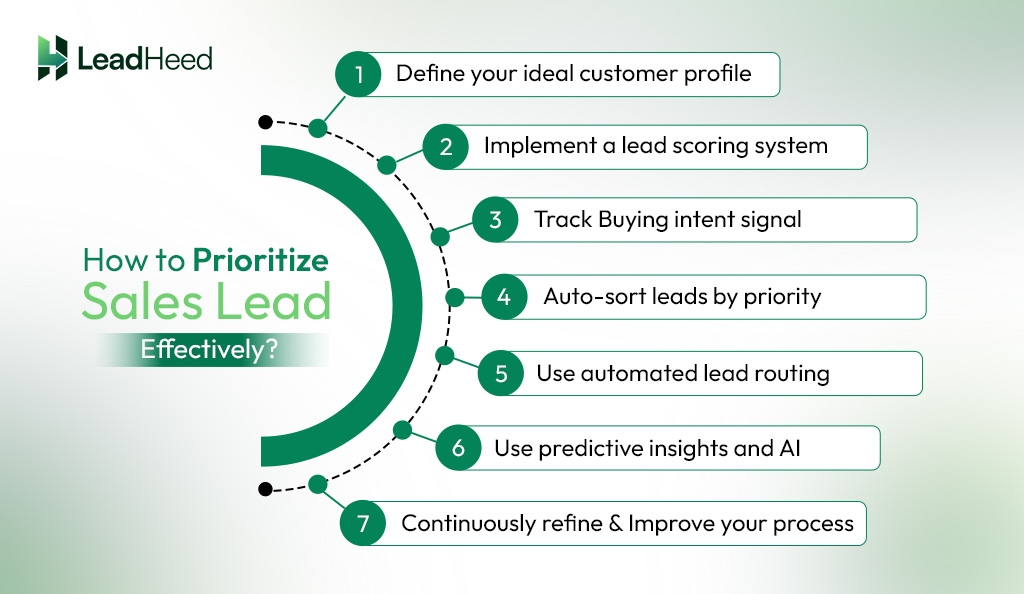
To prioritize sales leads, you should focus on the most promising prospects first, by using lead scoring, buying signals, and AI insights to improve conversions and drive revenue.
1. Define Your Ideal Customer Profile
The first step in prioritizing sales leads is understanding who your best customers are. Your ideal customer profile (ICP) describes the type of business or person most likely to buy and get the most value from your product.
ICP allows you to filter leads by the specific industry, size, and challenges your solution is designed to solve. When your ICP is clearly defined, your team stops chasing everyone and starts focusing only on leads that are a match to your product.
2. Implement a Lead Scoring System
A lead scoring system helps you rank leads based on how well they fit your ideal customer profile and how interested they are in your product. It helps your sales teams prioritize the sales leads that are most likely to convert into customers.
The lead scoring method combines the demographic data (company size, industry, location) and behavioral data (website visits, content downloads) to create a final score. As leads interact more with your business, their scores change, keeping priorities up to date.
3. Track Buying Intent Signals
Buying intent signals show how actively the leads are involved in the purchasing process rather than just browsing. Actions such as visiting pricing pages, downloading product-focused content, requesting demos, or actively using a free trial indicate a strong intent to purchase.
By tracking these signals, sales teams can see high-quality leads who are ready for conversation and purchase. It makes easier to prioritize outreach, respond at the right time, and avoid wasting effort on people.
4. Auto-Sort Leads by Priority
Your CRM can automatically segment the leads based on their value and engagement level, labeling them as hot, warm, and cold leads.
For instance, a hot lead is one that matches your ICP and has shown strong interest; a warm lead is someone who matches your ICP but is less active; and a cold lead shows little interest or isn’t a match. The categorization helps your sales teams identify the leads that need instant attention.
5. Use Automated Lead Routing
Utilize lead routing rules to automatically assign incoming leads to the right sales rep the moment they show buying intent. It improves speed-to-lead and prevents high-value prospects from getting stuck in a general queue. Routing can be based on clear criteria like territory, industry, company size, product interest, or deal value, so each lead goes to the rep best equipped to convert them.
Hot leads get immediate attention when interest is highest, warm leads are guided until they are ready, and cold leads are not forgotten. This way, your team responds at the right time without treating every lead the same.
6. Use Predictive Insights and AI
These days, many businesses use predictive insights and AI to identify the hidden patterns that humans might miss. They use smart algorithms to analyze past data and identify the leads that have a high chance of becoming customers.
While standard lead scoring relies on rules you create manually, predictive models can analyze thousands of data points at a time to calculate the probability of closing. If an AI detects that a new lead looks exactly like your top 10% of customers from last year, it can instantly move that prospect to the top of the list.
7. Continuously Refine and Improve Your Process
Finally, the last step in prioritizing your sales leads is continuously refining and improving your process. As lead prioritization isn’t a one-time task, it should continually evolve with market shifts and customer preferences.
You can measure the efficiency of lead prioritization by monitoring key metrics like conversion rates, average sales cycle length, and lead response time. Then, use that data to refine your sales strategies.
Conclusion
Prioritizing sales leads is essential for growing revenue and improving ROI in 2026. While treating every lead the same wastes time and slows teams, prioritizing sales leads through a centralized CRM allows you to identify high-value prospects. This ensures your teams never miss a critical follow-up.
When you define your ideal customer, track buying signals, automate lead sorting, and continuously improve your process, your sales outreach becomes smarter, faster, and more effective. The result is better productivity, stronger relationships, and higher conversions.
If you’re serious about increasing conversions and ROI in 2026, it’s time to move beyond spreadsheets and guesswork. A smart CRM like LeadHeed helps you identify high-value leads, automate prioritization, and guide your sales team to focus on the prospects that truly matter.
FAQs
How does lead scoring help prioritize sales outreach?
Lead scoring helps prioritize sales outreach by assigning points to the lead based on their engagement level and readiness to buy, thus sales teams focus on the most promising prospects.
How to prioritize your sales leads?
To prioritize your sales leads, follow the following steps:
- Define Your Ideal Customer Profile
- Implement a Lead Scoring System
- Track Buying Intent Signals
- Auto-Sort Leads by Priority
- Route Leads Based on Lead Temperature
- Use Predictive Insights and AI
- Continuously Refine and Improve Your Process
What are the 5 P’s of prospecting?
The 5 P’s of prospecting are Purpose, Preparation, Personalization, Perseverance, and Practice. Together, they form a strategy for finding, researching, and consistently engaging the right leads.