

According to WebFX, 82% of companies use CRM for sales process automation and sales reporting. CRM software centralizes all your leads in one place and helps you manage your prospects with a clear workflow.
Taking a look at some examples of CRM gives you an idea of how companies use the software to get better results. CRM software examples highlight a clear change and the business impacts it created for companies.
5 Surprising CRM Statistics You Must Know
CRM has moved far beyond contact data storage. Teams now use CRM software to automate routine work, improve sales reporting, and bring sales, marketing, and support into one connected process.
- 91% of businesses with 11+ employees use CRM systems.[demandsage]
- Businesses using CRM have seen a 45% increase in sales revenue.[llcbuddy]
- The average ROI of CRM is $8.71 for every $1 spent.[nucleusresearch]
- Companies using CRM have seen a 17% increase in lead conversions.[martech]
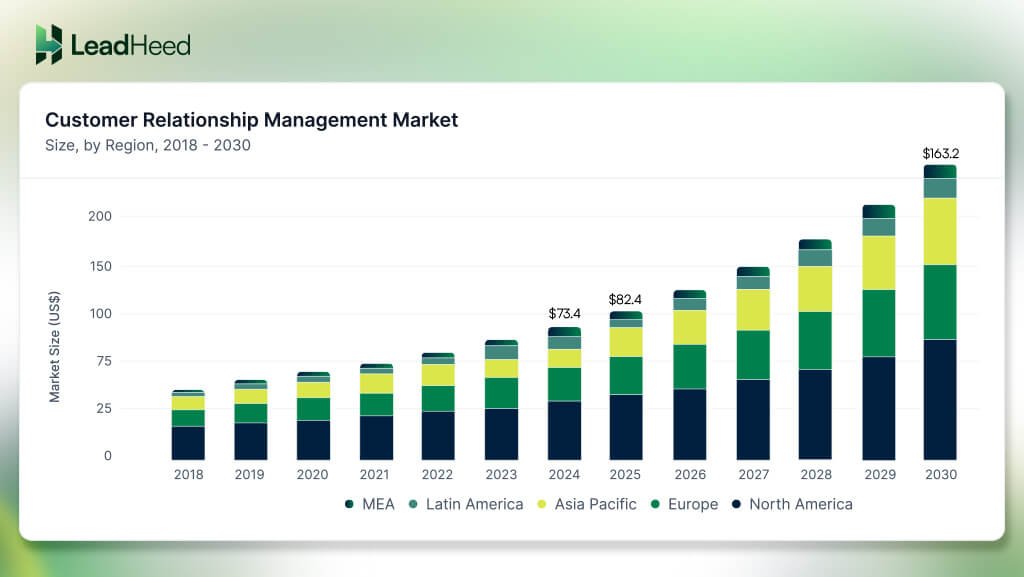
- The global CRM market is projected to reach $163.16 billion by 2030.[grandviewresearch]
What Do You Consider a Good CRM Example?
A good CRM example should include a clear business problem, a specific CRM practice the company followed, and the measurable business impact it created. The best examples must feel practical because they describe steps you can repeat in your own workflow.
A strong CRM software example includes:
1. Problem (what was broken):
Leads got missed, follow-ups happened late, data stayed messy, or deals got stuck in the sales pipeline.
2. CRM move (what changed in the system):
The team set pipeline stages, added lead qualification rules, assigned owners, created tasks, or used CRM automation for reminders and handoffs.
3. Result (what improved):
Faster response time, higher conversion rate, shorter sales cycle, more deals closed, or better forecast accuracy.
10 Real-world CRM Software Examples
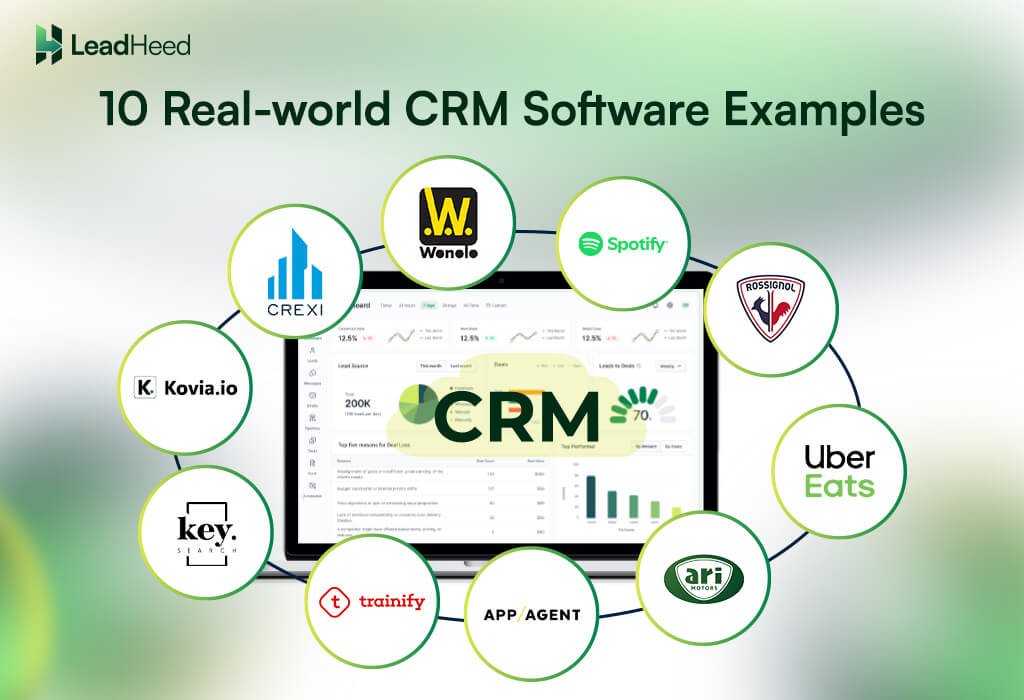
Below are 10 inspirational examples of CRM implementations that your teams across departments (sales, service, marketing, and more) can apply to turn prospects into customers.
1. Crexi: AI summaries and automated personalized emails
Crexi is a commercial real estate marketplace and technology platform where brokers, buyers, and tenants lease, buy, and sell commercial real estate.
The company’s sales reps spent critical time on administrative work like drafting emails, writing call notes, and doing customer research. It reduced the time they could have used to reach leads to drive deals.
How CRM Helped Crexi?
- The CRM generated quick prospect summaries, so reps had a customer context before reaching out.
- It created structured call summaries with key takeaways, action items, and customer sentiment, so the team stayed aligned and consistent.
- Crexi used CRM to draft personalized follow-up emails using contact, account, and conversation history, which helped reps follow up faster.
- The CRM recommends the next best step for each opportunity based on insights. It reduced hesitation and kept deals progressing.
Using CRM software helped Crexi save 5 hours per rep per day on administrative tasks. Now, their sales team is 80% more focused on customer engagement.
2. Wonolo: AI replies and a unified service workspace
Wonolo connects local businesses with workers for shift-based jobs. Its support team handles requests from both sides of the marketplace, so speed and consistency directly affect customer trust.
Wonolo’s support team used to spend too much time writing responses from scratch, searching across systems for context, and keeping answers consistent. New agents also needed more time to reach the expected quality level.
How CRM software helped Wonolo?
- The CRM they used centralizes customer and job context in one record, so agents have a 360-degree view of customer data.
- Wonolo used omnichannel routing to route requests to the right team using clear categories and queues. It reduced back-and-forth transfers.
- The CRM suggested reply drafts for common questions, so agents were able to respond faster while keeping tone consistent.
- Their CRM had internal help content and reusable templates that provided them with standardized guidance for improved training and quality.
Wonolo had a 20% decrease in average handle time for newer agents and a 12% decrease for experienced agents.
3. Spotify: One source of advertiser data for faster campaign execution
Spotify runs a large advertising business that supports brands and agencies with campaign planning, targeting, and performance reporting.
Its advertising team used to deal with scattered client data and slow campaign reporting. It made it harder to work fast and launch personalized campaigns at scale.
How CRM Helped Spotify?
- The CRM unified advertiser and client data into a single source, so teams could plan and execute campaigns with complete context.
- It automated activity tracking for the sales team, so managers and reps could track progress without manual updates.
- Spotify used CRM automation to collect and process campaign data faster, reducing reporting cycles from months to under a week.
- The CRM supported personalized web content based on past user activity, which improved engagement and campaign performance.
- It improved collaboration across teams with real-time updates and automated workflows, which reduced meetings and long email threads.
Spotify increased sales productivity by 40% and improved client data query speed by 95%. The company also reported 19% year-over-year advertising revenue growth and a 53% increase in click-through rates.
4. Rossignol: Personalized campaigns and 3x more marketing output
Rossignol is a global sports and lifestyle brand known for ski equipment and mountain products. The company expanded beyond winter sports and started selling for multiple seasons, which increased the need to engage different customer groups at different times.
Rossignol lacked the insight and connection it needed to build personal relationships at scale. Customer data sat across touchpoints, so the team could not consistently match the right message and product to the right person at the right time.
How CRM Helped Rossignol?
- The CRM brought customer data together across channels (such as browsing history, purchases, and service conversations)—a 360-view of potential customers.
- Rossignol used CRM software to personalize weekly emails and messages based on real behavior (views, purchases, abandoned carts).
- The CRM automated customer journeys, translated campaign content into multiple languages, and helped send messages at better times.
- Rossignol tailored marketing campaigns, landing pages, and product recommendations based on customer interests, locations, and even weather signals.
Rossignol increased weekly marketing campaigns by 300%, doubled the contribution of CRM to ecommerce revenue in less than three years, and achieved 28% group growth for the financial year ending March 2023.
5. Uber Eats: Unified customer and merchant data
Uber Eats is a food delivery platform that serves merchants and consumers across 6,000 cities worldwide.
Before using a stronger CRM workflow, Uber Eats support agents had to pull order, payment, and refund details from 30+ separate systems to understand a single case. It resulted in delays and increased handle time, especially during merchant disputes and refund-related requests.
How CRM helped Uber Eats?
- CRM integrations pulled case data from many systems into one view, so agents spent less time triaging and more time resolving.
- Uber Eats used CRM to bring user, order, and refund details into a single record. Agents didn’t need to switch between tools just to understand the issue.
- The CRM included self-serve onboarding workflows, so merchants could sign up, upload menus, and share photos without long agent calls.
- Automated routing assigned the right work to the right agent based on skill and capacity, which improved productivity at scale.
Uber Eats agents can now resolve merchant disputes in seconds, instead of spending minutes collecting data across systems. CRM helped them remove manual searching that previously took up to two minutes per case.
6. Ari Motors: A structured pipeline to scale sales
Ari Motors is a German company that sells small electric commercial vehicles for B2B customers, from electric transporters to cargo mopeds.
Ari Motors used to manage customer data and sales activity with basic tools like spreadsheets and email. As demand grew, the sales process became confusing and hard to control. The team needed one system to manage more leads, track more deals, and keep every opportunity moving with full visibility.
How CRM Helped Ari Motors?
- Ari Motors used CRM to centralize customer information, buying activity, and buying history in one place.
- It replaced scattered files with clear sales pipeline visibility, so the team could see deal status at a glance and act faster.
- Ari Motors built multiple pipelines aligned to different customer journeys, which helped the team manage specialized sales flows without confusion.
- The company used pipeline automation to handle routine tasks, so sales reps spent less time on admin work and more time selling.
- The CRM helped them generate leads from their website as well, which helped maintain a steady flow of new inquiries.
Ari Motors increased sales 10x, generated 10x more inquiries, and grew its team from 2 to 31 employees after adopting a structured workflow.
7. AppAgent: Centralized leads and deals with a clear sales pipeline
AppAgent is a growth and marketing agency that helps mobile app and game companies improve app performance and user growth.
Before adopting CRM software, AppAgent did not have a centralized database for contact and deal information. Data stayed siloed and duplicated, which created conflicts. The team also lacked a clear sales pipeline, so it struggled to track deal progress and understand how many deals were active at any time. Reporting stayed limited, so the team pulled very few insights from the sales process.
How CRM Helped AppAgent?
- The CRM created one cloud-based database for contacts and deals, which eliminated duplicate records and made data consistent across the team.
- It provided a visual sales pipeline, so the team tracked every deal stage clearly and monitored progress without confusion.
- The CRM reporting helped AppAgent track total pipeline value and changes in client behavior.
- The team used CRM automation to send activity reminders, including follow-ups at 30 and 90 days after winning a deal.
AppAgent doubled its employee count from 15 to 30 while using a structured CRM workflow, and the company reported revenue improvement after adoption.
8. Trainify: CRM and email marketing in one tool
Trainify is a Latvian corporate education company that runs training programs and manages ongoing communication with prospects and customers.
Trainify used to rely on separate tools for email marketing and customer tracking. The team had to export and import data to run campaigns. It slowed down campaign preparation and made it harder to keep leads organized in one workflow.
How CRM Helped Trainify?
- The CRM combined contact management and email marketing in one place, so the team managed leads and campaigns from the same system.
- Trainify used the same contact database for segmentation and targeting, so marketing and sales stayed aligned on the same lead information.
Trainify no longer needs to import/export data manually. Using CRM software, they saved 2 hours per week in campaign preparation.
9. Key Search: 100+ automations and a 40% faster workflow
Key Search is a boutique executive search firm in Switzerland. It hires top executives for well-known brands and digital startups.
Before using CRM software, Key Search relied on an outdated system that was hard to use and difficult to customize. The team also handled a lot of repetitive work, so different people added different notes and reminders in different ways, which slowed the process and reduced consistency.
How CRM Helped Key Search?
- The CRM gave the team a single place to manage pipelines and relationships, so everyone worked with the same data and the same process.
- Key Search used CRM automation to handle repetitive steps, so the system created reminders and nudges instead of relying on manual notes.
- The CRM supported multiple workflows in one place (pipelines, invoicing, partner relationships, revenue forecasts, and marketing), so the team no longer needs to switch between tools.
- Key Search used CRM integrations to send more personalized emails and documents, instead of sending generic messages.
Key Search implemented 100+ automations and made its workflow 40% faster. The company reported immediate time savings and higher revenue due to better productivity.
10. Kovai.co: A clear CRM reporting and forecasting
Kovai.co is an Indian SaaS company that builds products for B2B teams worldwide. One of its major products, Document360, helps companies create and manage online knowledge bases.
Kovai.co’s sales team didn’t have a clear workflow. The team spent too much time trying to understand the state of sales instead of focusing on qualified outreach and conversion.
How CRM Helped Kovai.co?
- The CRM provided clear forecasting and sales pipeline, so the team could have a single view of the deals, and track revenue expectations in the workflow.
- The CRM synced with marketing tools, so sales and marketing stayed aligned on the same prospect data and outreach timing.
Kovai.co grew the Document360 sales team by 50% and ran 3 separate sales processes (inbound, outbound, nurture) with clearer forecasting and pipeline control.
Use LeadHeed CRM for Your Business to Set an Example
In all of the 10 examples of customer relationship management, we have seen companies following a shared approach: centralizing leads, qualifying prospects, and managing deals through clear sales pipelines.
LeadHeed can help you set an example with its all-in-one CRM software. It helps you generate more leads, qualify and manage your prospects, and move them through clear sales pipelines to close more deals.
If you want a CRM that improves execution and helps your team convert more prospects into customers, LeadHeed gives you the workflow to do it. Start your 14-day free trial today!!
FAQs
What is CRM software and examples?
CRM software is a system that helps you capture leads, organize customer data, and manage deals through a clear sales pipeline until you close. Examples of CRM software include LeadHeed, HubSpot CRM, Salesforce, Zoho CRM, and Pipedrive.
What are the 4 types of CRM?
Most businesses group CRM into four practical types:
- Operational CRM: runs daily work like lead management, follow-ups, and sales pipeline stages.
- Analytical CRM: focuses on CRM reporting, insights, forecasting, and performance tracking.
- Collaborative CRM: improves coordination across sales, support, and marketing with shared customer context.
- Strategic CRM: supports long-term customer retention and growth using lifecycle and relationship planning.
Is Excel a CRM software?
Excel can store contacts, but it is not a true CRM software. It does not reliably manage leads, automate follow-ups, track conversations, and enforce sales pipeline stages.
What is a real-life CRM example?
A real-life CRM example is a sales team capturing website inquiries as leads, qualifying them, converting them into deals, and moving those deals through sales pipeline stages (contacted → demo → proposal → negotiation → closed).
How do you measure success after implementing a CRM system?
You can measure the success of CRM with the following business metrics:
- Lead response time
- Lead-to-deal conversion rate
- Deal stage conversion rates
- Sales cycle length
- Win rate