

High revenue doesn’t always mean high profit. Many businesses feel proud of growing sales, yet feel confused and frustrated when profits quietly shrink. When return on sales is ignored, serious warning signs go unnoticed, like rising costs, poor efficiency, and deals that bring in money but not real profit.
Return on sales shows how much profit you make from each unit of revenue. It helps you understand your real business performance and compare it with competitors.
Highlights
- Return on Sales (ROS) shows how much profit your business makes from every dollar of sales and measures the business’s efficiency.
- To calculate ROS, divide the operating profit by your net sales and multiply by 100 to get the ROS percentage.
- While the ROS formula shows how efficiently you turn sales into profit, it doesn’t account for taxes, interest, or how different industries operate.
- You can boost ROS by smarter pricing, lower costs, improved sales, customer segmentation, maintaining high quality, and using sales data.
- While ROS measures daily sales efficiency, ROI tracks investment success, ROA assesses how assets generate money, and Operating Margin reflects profit after operating expenses.
What Is Return on Sales (ROS)?
Return on Sales (ROS) is a financial ratio that measures a company’s operational efficiency by showing how much profit you earn from every dollar of sales. It focuses on the core business performance by evaluating how well a company manages its operating costs, such as production, administration, and marketing, compared to its sales.
- An increasing ROS indicates improved efficiency, with maximized profit.
- A decreasing ROS indicates weaker operational efficiency or higher operating expenses relative to revenue.
How to Calculate Return on Sales?
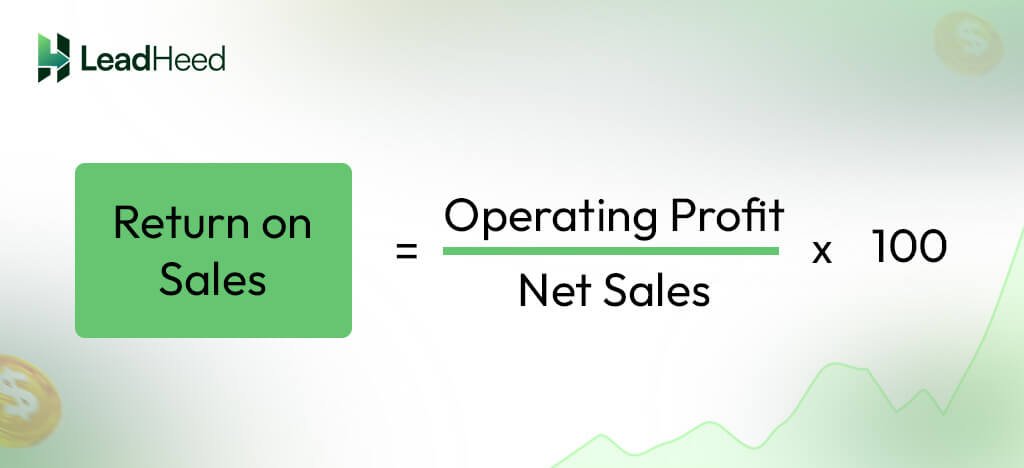
To calculate return on sales, divide your operating profit (also known as operating income) by net sales (revenue), then multiply the result by 100 to get a percentage.
Mathematically,
Return on Sales = (Operating Profit / Net Sales) x 100
where,
- Net Sales: Total money your business earns from sales, after subtracting refunds, discounts, and returns.
- Operating profit: The profit a business makes after paying all direct costs and operating expenses, such as production costs, salaries, rent, and marketing. It does not include taxes or interest.
Understanding ROS Formula with a Practical Example
Suppose a company has $600,000 in net sales and $400,000 in total operating expenses.
1. Calculate Operating Profit:
Operating Profit = Net Sales – Operating Expenses
$600,000 – $400,000 = $200,000
2. Calculate ROS Ratio:
ROS = Operating Profit / Net Sales
$200,000 / $600,000 = 0.33
3. Convert to Percentage:
0.33 * 100 = 33%
Result: The company has a 33% ROS, meaning it earns 33 cents in profit for every dollar of sale.
What Factors Affect Return on Sales (ROS)?
Operating expenses, sales volume, Cost of Goods Sold, gross margin, and competitor trends are the factors affecting your ROS.
- Operating Expenses: These are the costs acquired on salaries, rent, utilities, and other marketing costs. When your operating expenses are higher, you have less profit, which lowers overall ROS.
- Sales Volume: As your sales volume increases, it dilutes fixed costs, like rent or salaries, over a greater number of sales. This reduces the operating cost per unit, which raises your net profit margin and directly increases your ROS (Return on Sales).
- Cost of goods sold (COGS): COGS includes direct costs such as materials, direct labor, and manufacturing or delivery costs. When COGS rises faster than sales, due to higher input prices, waste, or inefficiency, ROS declines.
- Gross Profit Margin: Gross profit margin shows how much money you keep from each sale to cover your daily business costs. A higher gross margin means you keep more money per sale, which increases profit and boosts your ROS.
- Competitor Trends: Your Return on Sales (ROS) is strongly influenced by competitors’ pricing and market strategies. For instance, you may be forced to lower prices or improve cost controls to stay competitive, which can reduce your profit margins.
Limitations of the Return on Sales
Return on Sales (ROS) is useful for tracking profit efficiency, but it can be misleading since it doesn’t reveal actual profit in cash terms and varies widely across industries, making comparisons unfair.
- The ROS formula is calculated as a percentage, so it doesn’t reflect how much profit a company really makes in dollar terms.
- It cannot be used to compare companies from different industries (e.g., retail vs. software) because industries have different cost structures and typical profit margins.
- Because it uses EBIT (Earnings Before Interest and Taxes), ROS excludes interest costs and other financial factors that affect real performance.
- ROS can fluctuate due to seasonal demand or temporary events, so a single-year ROS may be misleading.
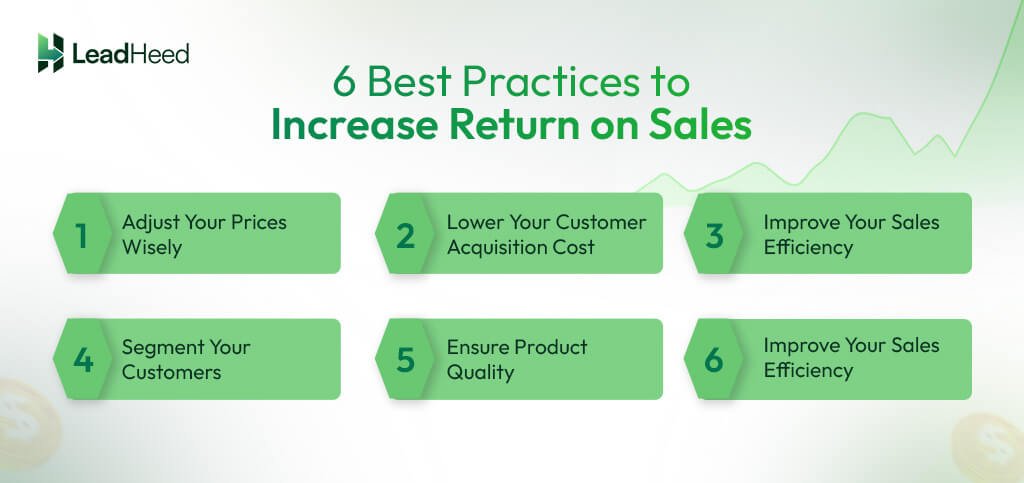
6 Best Practices to Increase Return on Sales (ROS)
To increase return on sales, companies can refine pricing, lower customer acquisition costs, streamline sales operations, and segment customers to focus on the most profitable groups. Maintaining high product quality and using sales insights to guide decisions also helps boost margins and overall profitability.
1. Adjust Your Prices Wisely
Your pricing should reflect both your costs and the value customers see in your product. If prices are too low, even strong sales cannot bring healthy profits.
Review your market, competitors, and customer demand regularly. It helps you understand your customers’ needs, what they value most, and how sensitive they are to different price levels in your market.
2. Lower Your Customer Acquisition Cost
You know the saying, “keeping an old customer is cheaper than finding a new one”. When you spend a lot on advertising and cold calling just to attract a few new customers, your ROS suffers.
Therefore, you should focus on channels that bring high-quality leads, such as social media ads, referrals, etc. Also, improve your website experience, target the right audience, and nurture existing leads better. The less you spend to close a sale, the more profit you keep from it.
3. Improve Your Sales Efficiency
If your sales team is wasting their time on leads that never close, your operational efficiency declines. Yet you can improve the value of every sales interaction by using CRM tools to automate workflows and prioritize leads.
With better pipeline visibility, faster follow-ups, and data-driven lead scoring, reps spend more time selling and less time on admin tasks. The result is shorter sales cycles, a smooth sales process with less effort, higher win rates, and improved return on sales.
4. Segment Your Customers
Not all your customers bring the same value to your business. Some require high maintenance but generate low revenue, while others buy premium packages with very little effort on your part.
So, you can segment your customers based on their behavior, needs, and budget. It allows you to focus on the segments that generate higher profit rather than wasting time on those who does not have much value.
5. Ensure Product Quality
Quality products aren’t just nice to have; they quietly grow net sales by keeping customers satisfied and improving customer experiences.
When you deliver high-quality products, customers are more likely to buy again and recommend your brand. This builds customer trust and increases revenue without requiring a new marketing spend.
6. Utilize Your Sales Data
Your sales data holds valuable clues about your business. It shows which products people love, when sales slow down, and how customers usually buy. You can analyze your data to identify sales patterns and use predictive analytics for smarter sales decisions.
For instance, if you know a certain product sells well in March, you can stock up early at a lower price. This cuts your cost of goods sold and directly improves your return on sales once the busy season arrives.
Comparing ROS with Other Financial Metrics
Return on Sales (ROS) is a core profitability KPI that shows how much operating profit you earn from every dollar of revenue. However, other financial metrics, like ROI, ROA, and operating margin, highlight sales performance from investment, asset usage, and operating efficiency.
1. Return on Sales (ROS) vs Return on Investment (ROI)
As mentioned above, ROS (Return on Sales) shows how much money your business generates from daily sales. On the other hand, ROI (Return on Investment) shows how much profit is earned from a particular investment, such as a marketing campaign or CRM implementation. Both metrics are important, but ROS gives a broader view of sales profitability.
2. Return on Sales vs Return on Assets (ROA)
Return on sales and return on assets (ROA) are complementary profitability indicators. ROS measures operating profit margin relative to net sales, showing how efficiently a company manages its core production and overhead costs. In contrast, ROA measures net income relative to total assets, indicating how effectively the company uses its resources (like equipment, inventory, and cash) to generate a final profit.
3. Return on Sales vs Operating Margin
Return on Sales and operating margin both measure operating profit as a percentage of total sales, but the main difference between them lies in their numerator. While ROS is based on earnings before interest and taxes (EBIT), operating margin uses operating income, reflecting profit after regular operating costs and accounting changes.
Conclusion
Return on Sales (ROS) tells you how much operating profit your business earns from every dollar of revenue. When you track ROS consistently, you can catch rising costs early, fix weak pricing, and focus on the customers and products that actually improve margins.
But measuring ROS gets much easier when your sales numbers are clear. LeadHeed helps you track the revenue side of ROS by showing your total deal value, won deal value, lost deal value, lead-to-deal conversion rate, reasons for lost deals, and average time to close—all in one dashboard. It helps you spot where revenue is leaking (stuck deals, high losses, slow cycles) and make smarter decisions that protect profitability.
If you want a simple way to keep your sales performance organized and measurable, LeadHeed gives you the insights to track what’s working and improve what’s not. Sign up for free!!
FAQs
Is EBIT the same as ROS?
No, EBIT and ROS are not the same. EBIT shows the profit amount before interest and taxes, and ROS is the ratio of EBIT to net sales
What is a good return on sales ratio?
A good return on sales ratio varies by industry, but here’s how you can evaluate:
- 5% or less: Low
- 5%–10%: Average
- 10% or more: Good
For example, grocery and retail businesses often have a low ROS because their costs are high, while software or tech companies usually have a higher ROS.
How is ROS calculated?
You can calculate ROS using the simple return on sales formula: ROS = Operating profit / Net Sales
Is 12% a good ROE?
Yes, a 12% ROE is generally considered good. It means the business is making about $12 in profit for every $100 invested by shareholders. However, its quality still depends on the industry.